Top-Down Analysis in Forex: From W1 to Entry
Start with the weekly chart and drill down to your entry timeframe. The complete top-down forex analysis methodology from W1 bias to precise H1 or H4 entry.
Published on 4 June 2026
Most trading mistakes happen before the entry. Not at the entry.
They happen when a trader identifies a compelling H1 setup without checking the H4 structure. Or takes an H4 trade without establishing what the daily chart is doing. Or builds an entire trade thesis on the D1 without ever looking at the weekly context that determines whether the D1 move is a trend continuation or a counter-trend bounce.
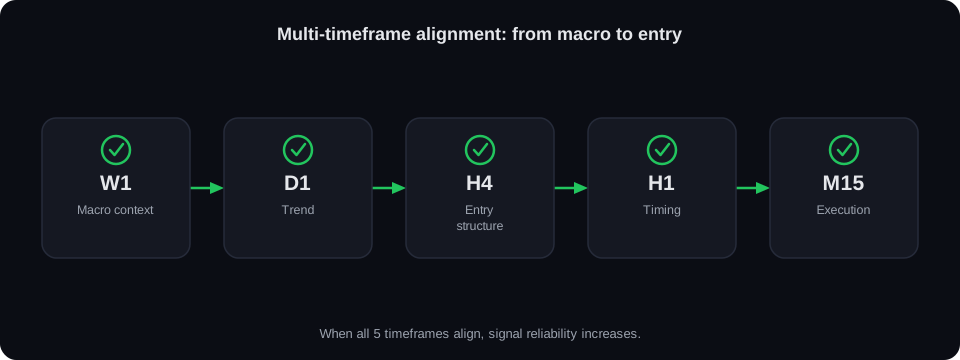
Top-down analysis solves this by making the sequence of analysis explicit and non-negotiable: always start with the highest timeframe and work down. Each timeframe defines the context for the one below it. The weekly sets the regime for the daily. The daily sets the context for the H4. The H4 defines the entry zone for the H1. Nothing on a lower timeframe overrides what the higher timeframe has established.
This is not a trading strategy — it is a methodology that improves any trading strategy. Whether you trade reversals, breakouts, or pullbacks, applying top-down analysis ensures that every trade you take has the full weight of multi-timeframe evidence behind it.
Why Top-Down, Not Bottom-Up
The instinct of most retail traders is bottom-up analysis: find an interesting pattern on H1 or M15, then look for reasons it might work. The search is motivated by the pattern already seen — confirmation bias is built into the process from the start.
Top-down analysis reverses this. You establish the macro context first, which tells you the direction to look for trades in. Then you define the structural levels where a setup might form. Only then do you watch lower timeframes for entry signals — and only in the direction the higher timeframes have already established as favourable.
The practical difference is profound. A trader doing bottom-up analysis sees an H1 bullish setup and looks for reasons to take it. A trader doing top-down analysis has already determined — from the weekly and daily charts — that only long setups have the macro wind at their back this week. The H1 bullish setup is not a discovery; it is the expected event that confirms a thesis established days earlier.
Bottom-up traders are reactive. Top-down traders are anticipatory. The same market event produces a different quality of decision depending on which methodology is in use.
The Four-Timeframe Hierarchy
Top-down forex analysis uses four timeframes, each serving a specific analytical purpose.
| Timeframe | Role in Top-Down Analysis | Key Questions Answered | Review Frequency |
|---|---|---|---|
| Monthly (MN) | Ultra-macro context; multi-year structure | Where is price in its 10-year range? | Monthly |
| Weekly (W1) | Macro regime; multi-year swing levels | Bull or bear? Key macro S/R? | Weekly |
| Daily (D1) | Primary directional bias; key levels | Trend direction, main S/R zones | Daily |
| H4 | Entry zone; setup structure | Where to enter within the D1 trend? | 3–4x per day |
| H1 | Precise entry trigger | Exact entry candle confirmation | At setup only |
Weekly (W1) — The Macro Regime
The weekly chart shows the market's behaviour over years of data. Each candle represents five trading days — a full working week of global market activity. The W1 chart is immune to the noise that dominates daily and intraday analysis: a piece of economic data that moves D1 significantly is often invisible on the weekly chart.
The W1 analysis answers one question: what is the macro regime for this pair?
Check the W1 MA alignment (MA20 vs MA50 on weekly). Note the most significant multi-year swing highs and lows — these are the macro boundaries the pair has been operating within. Identify where price currently sits relative to those macro levels. Is the pair in the middle of its historical range, approaching a major resistance, or at a decade-low support?
The W1 analysis takes 30–60 seconds per pair once you are familiar with the chart. Its output is a single classification: macro bullish, macro bearish, or macro transitional. This classification does not change quickly — W1 regimes typically persist for months or years. You do not need to re-examine W1 every day; a weekly review is sufficient.
Even at 30–60 seconds per pair, the W1 classification above adds up once you run it across an entire watchlist every week. Scanvey keeps the W1 MA alignment and macro regime visible for every pair alongside the lower timeframes below, so the weekly review described above stays a single glance rather than a recurring per-pair task.
Daily (D1) — The Directional Bias
The D1 chart is the primary working timeframe for most forex swing traders. Each candle represents 24 hours of combined global session activity: Asian, London, and New York. It is the chart that filters daily noise while remaining responsive enough to capture meaningful medium-term trends.
The D1 analysis answers: what is the current trend direction, and where are the key levels?
Check the D1 MA alignment (MA50 vs MA200). Assess RSI: above or below 50? Check MACD direction. Identify the key D1 support and resistance levels — the structural zones where the most significant price reactions have occurred in the past three to six months.
The output of D1 analysis is a directional bias (bullish or bearish) and a set of marked levels where setups might form. If the D1 bias conflicts with the W1 macro regime, treat the trade as counter-trend: reduce size and apply stricter entry conditions.
When D1 and W1 agree — both bullish or both bearish — the setup has the maximum directional weight available from the timeframe hierarchy.
H4 — The Entry Zone
The H4 chart is where you identify the specific zone where a trade will form. It bridges the macro/medium-term context of the daily chart and the precise entry timing of the hourly chart.
The H4 analysis answers: where specifically within the D1 structure might the entry form, and what indicators suggest it is approaching?
On H4, check the MA alignment relative to D1. Is H4 aligned with D1 (confirming the trend) or temporarily counter-directional (suggesting a correction is in progress)? Identify H4 structural levels — swing highs and lows that price has reacted to within the past few weeks. Map how these H4 levels relate to the broader D1 levels identified earlier: ideally, an H4 level coincides with a D1 level (level confluence).
Watch for H4 RSI and MACD conditions that signal the correction phase is ending. As a pullback matures — H4 RSI declining toward 40–45, MACD histogram negative but flattening — the setup is developing. When H4 RSI begins recovering above 50 and MACD histogram turns from negative to positive at a key level, the entry zone is activating.
H1 — The Entry Trigger
The H1 chart provides the precise entry signal. By the time you are looking at H1, all the higher-timeframe work is done: the W1 regime is known, the D1 bias is established, the H4 entry zone is identified. H1 is purely about timing.
The H1 analysis answers: is a specific entry signal forming right now at the H4 zone?
Look for H1 candle patterns at the H4 level: a pin bar, bullish engulfing, or doji with a close back above the support zone. Look for H1 MA crossovers (MA10 crossing above MA50 on H1) as mechanical entry triggers. Look for H1 RSI crossing above 50 as momentum confirmation at the H1 level.
The entry is placed when the H1 trigger fires within the H4 zone, which sits within the D1 structure, which is aligned with the W1 macro regime. Every timeframe layer has been checked. Every layer is pointing in the same direction. The stop goes below the H4 structural level. The target is the next D1 structural resistance.
Working Through the Process: A Complete Example
To make the methodology concrete, here is a full top-down walkthrough on EUR/USD.
W1 review (Monday morning): EUR/USD is above its W1 MA20 and MA50. The weekly MA50 has been sloping upward for four months. Price is in the upper half of a range established over the past two years. No major multi-year resistance levels are nearby. Macro regime: bullish.
D1 analysis: The D1 MA50 is above the MA200 — golden cross intact. RSI is at 56: above 50, bullish momentum confirmed. MACD histogram is positive. The pair has been in a clear uptrend for six weeks. After a recent advance to 1.1050, a pullback is in progress. The D1 MA50 is currently at 1.0860, and a prior swing high (now potential support) sits at 1.0870. Directional bias: bullish. Key level: 1.0860–1.0875.
H4 analysis: H4 is in corrective mode — the H4 MA10 has crossed below the MA50, confirming the pullback. H4 RSI has declined to 44. MACD histogram is negative but flattening as price approaches the 1.0860–1.0875 zone. The H4 Kijun-sen sits at 1.0865 — coinciding with the D1 level. Entry zone: 1.0860–1.0875, multiple confluent levels. Price is 20 pips above the zone. Watch for H4 or H1 entry signal.
H1 trigger watch: Two days later, price reaches 1.0868. An H1 pin bar forms with a long lower wick to 1.0855 and a close at 1.0875. H1 RSI crosses above 50. H1 MA10 crosses above MA50. The entry signal is confirmed. Entry: long at 1.0878. Stop: below 1.0845 (below pin bar wick). Target: 1.1020 (prior D1 resistance). Reward-to-risk: approximately 5:1.
Every timeframe contributed to the trade: W1 established the macro bullish regime. D1 provided the directional bias and identified the key level. H4 confirmed the entry zone and tracked the correction's maturation. H1 provided the precise entry trigger. The stop is placed logically at the level where the analysis is invalidated. The target is anchored to the next D1 structural level.
This is top-down analysis producing a trade — not a reaction to a pattern spotted on H1, but the culmination of a multi-timeframe analytical process.
Handling Timeframe Conflicts
The top-down methodology provides clear guidance for handling conflicts between timeframes: higher timeframe always wins.
W1 bullish, D1 bearish: The D1 is in a correction within a W1 uptrend. The D1 bearish move is likely a multi-week pullback before the W1 trend resumes. Do not take short setups on D1 against the W1 regime unless there is extremely compelling structural evidence. Instead, wait for the D1 correction to complete and look for long re-entry setups.
D1 bullish, H4 bearish: The H4 is in a corrective phase within the D1 uptrend. This is the most common configuration for high-quality pullback entries — the setup is developing. Do not take H4 short setups against the D1 trend. Monitor the H4 for signs the correction is completing (RSI recovering toward 50, MACD histogram flattening) and position for the long re-entry.
H4 bullish, H1 bearish: The H1 is temporarily dipping within an H4 uptrend. Either wait for H1 to recover and trigger a long entry, or reduce timeframe sensitivity and enter on an H4 signal directly without waiting for H1 confirmation.
W1 and D1 conflicting (W1 bearish, D1 bullish): This is the most significant conflict — macro and medium-term disagree. In this situation, the D1 bullish move is likely a counter-trend bounce within a larger W1 downtrend. Treat all D1 long setups as counter-trend: apply stricter entry criteria, reduce position size to 50% of normal, and take profit earlier than the full structural target.
The consistent principle: never use a lower timeframe to override a higher timeframe's direction. Lower timeframes refine the timing of higher-timeframe analysis; they do not change its conclusions.
Top-Down Analysis and the Weekly Routine
The top-down methodology maps naturally to a structured weekly and daily routine.
Weekend (Sunday evening): Run W1 analysis for the full watchlist. Classify each pair's macro regime. Identify any pairs approaching major W1 structural levels. Update D1 key levels for the week ahead. This sets the analytical context for the entire week in one session.
Daily (after D1 close, ~22:00 UTC): Update D1 analysis for pairs that have moved meaningfully. Has any pair's directional bias changed? Has price reached a key D1 level identified over the weekend? Are any H4 corrections approaching completion? Note pairs to watch closely at the next session open.
Pre-session (before London open, ~07:45 UTC): Check H4 charts for pairs on the active watch list. Has any pair's H4 structure shifted overnight? Is the entry zone within reach?
At H4 candle closes (08:00, 12:00, 16:00 UTC): Check H4 candle closes for pairs in the entry zone. Is the correction completing? Are H4 RSI and MACD recovering? Is an entry signal forming?
H1 monitoring (when H4 setup is mature): Once H4 signals that the entry zone is active, monitor H1 for the precise entry trigger.
This routine has a clear hierarchy of attention: the most time is spent at the highest timeframes (a thorough weekend review), with progressively less time needed at each lower timeframe as the work cascades down the hierarchy.
Why Top-Down Analysis Compounds Over Time
There is a compounding effect to the top-down methodology that takes time to fully appreciate.
When you have been performing the W1 and D1 analysis on the same pairs consistently for weeks, you begin to anticipate setups before they form. You know that EUR/USD is approaching a major D1 support zone in approximately four trading days. You know that GBP/JPY is in the final stages of a W1 correction that has historically been followed by a strong resumption. You are not reacting to the market — you are prepared for it.
This anticipatory awareness is one of the most significant advantages available to an organised, systematic trader over a reactive, pattern-chasing one. The market does not surprise prepared traders nearly as often as it surprises unprepared ones.
Tools that accelerate the analytical steps — like Scanvey, which displays MA alignment, RSI, MACD, and Ichimoku conditions across all pairs and all timeframes simultaneously — make the upper layers of the top-down hierarchy faster to assess. The W1 and D1 regime checks that once required opening thirty charts can be completed in a matrix scan in under two minutes, freeing analytical bandwidth for the H4 and H1 work where judgment and structure assessment remain entirely manual.
Conclusion
Top-down analysis is not a strategy — it is the analytical architecture that any strategy operates within. It provides the answer to the most fundamental question before any trade: "Is this trade with or against the dominant structure at every relevant timeframe?"
When the answer is "with the structure at every level," the trade has maximum directional support. When the answer reveals a conflict — a compelling H4 setup that runs counter to the D1 trend, or a D1 trend that contradicts the W1 macro regime — the methodology provides the framework to size down, adjust, or pass.
The discipline of always starting at the highest timeframe and working down is simple to state and genuinely difficult to maintain. The pull of an interesting lower-timeframe pattern is real; it is psychologically easier to jump straight to the entry signal than to spend time on the weekly chart confirming that the macro regime supports the trade. But the trades where this discipline is skipped are disproportionately represented in every trader's list of significant losses.
Start at the top. Every time.
Related articles:
- Multi-Timeframe Analysis: The Complete Guide
- Daily Chart Forex Analysis
- H4 Forex Trading Strategy: The Sweet Spot
- The Ultimate Forex Trading Checklist
Frequently asked questions
What is top-down analysis in forex trading?
Top-down analysis is a methodology for evaluating a forex pair or asset by starting with the highest available timeframe and working down to the entry timeframe. You establish the macro regime on the weekly chart first, then identify trend direction and key levels on the daily, then locate the entry zone on H4, and finally time the entry on H1 or M15. Each lower timeframe operates within the context established by the one above it — no lower-timeframe signal overrides what the higher timeframe has established.
How long does a complete top-down forex analysis take?
For a single pair with a clear setup already forming, a thorough top-down analysis takes 10–15 minutes. For a full watchlist scan of 6–8 pairs, expect 30–45 minutes if done manually. The most time-consuming step is the W1 and D1 regime classification for each pair — this is where automated matrix tools provide the most value, compressing the upper-timeframe checks into a quick scan before you begin the detailed H4/H1 work.
Which timeframe should I start top-down analysis on?
Always start on the weekly chart (W1). The weekly chart shows the macro regime — whether the pair is in a sustained uptrend, downtrend, or multi-month range — that determines which direction you should be looking for trades in. Starting on H1 or H4 because "that is where I trade" is the most common top-down mistake; you may identify a perfect-looking H4 setup that is directly against the weekly trend and is statistically unlikely to work.
Is top-down analysis better than bottom-up analysis in forex?
Yes, for most systematic traders. Bottom-up analysis — finding an interesting pattern on a lower timeframe and then looking for reasons to support it — is structurally prone to confirmation bias. Top-down analysis establishes the directional context first, which means lower-timeframe signals are evaluated for whether they fit the already-established case rather than discovered in isolation. The discipline of not acting on a setup that conflicts with the higher timeframe context is one of the most valuable risk management rules a trader can apply.
Do I need to redo the full top-down analysis every day?
No. The weekly and daily layers change slowly and typically only need reviewing once a week and once a day respectively. Only the H4 and H1 layers — the entry-zone and trigger levels — need to be re-checked each session, which is why an experienced top-down trader spends most of their daily routine on the lower two timeframes rather than re-deriving the whole hierarchy from scratch.
What happens when timeframes give conflicting signals mid-analysis?
When a lower timeframe contradicts the higher-timeframe bias, the higher timeframe wins by default — a bullish H4 setup inside a bearish D1 trend is treated as a lower-probability counter-trend trade, not a reason to override the daily bias. If conflicts become frequent across many pairs at once, that is usually a sign the higher timeframe itself is transitioning between regimes, which calls for smaller position sizes across the board until the picture clarifies. See what to do when timeframes give conflicting signals for the full set of decision rules.
Further reading
These reference resources complement the analysis presented in this article:
Related reading
Reference guide for this topicMulti-Timeframe Analysis: The Complete Forex & Crypto Guide
Align your timeframes in one click
W1, D1, H4, H1 and M15 shown side by side for every asset, no chart-switching required.
Try the multi-timeframe scannerThis article is for informational and educational purposes only. It does not constitute investment advice or a trading signal. Trading financial products involves a high risk of capital loss. Full risk disclaimer