Multi-Timeframe Analysis: The Complete Forex & Crypto Guide
Master multi-timeframe analysis in forex and crypto. Combine H1, H4, D1 and W1 to find high-probability setups and trade with the trend.
Published on 4 June 2026
Most retail traders lose money not because they lack discipline or intelligence — they lose because they look at the market through a keyhole.
They pick a timeframe, study it for hours, spot what looks like a perfect setup, enter the trade, and watch it fail within minutes. The signal was real. The analysis was correct. The problem is that they never looked up.
Multi-timeframe analysis (MTA) is the practice of examining the same asset across several timeframes before making any trading decision. It is the single most impactful habit that separates consistently profitable traders from the rest. This guide covers everything you need to know: the logic behind it, the methodology, the indicators, the common mistakes, and how to apply it efficiently in the real world.
What Is Multi-Timeframe Analysis?
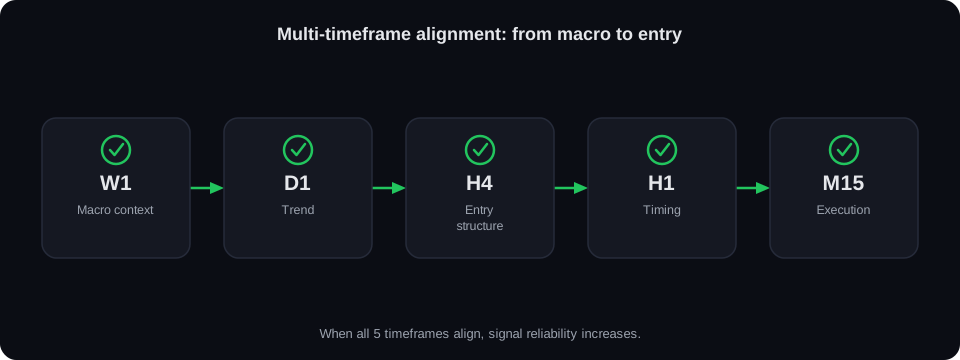
Multi-timeframe analysis means evaluating a currency pair or crypto asset on at least two or three different chart intervals — typically a higher timeframe to identify trend direction, an intermediate timeframe to find the entry zone, and a lower timeframe to time the entry precisely.
The core idea is simple: price action on a lower timeframe only makes sense in the context of a higher timeframe. A bullish M15 candle means nothing if the D1 is in a confirmed downtrend. A golden cross on H1 is far more powerful when the H4 and D1 are already trending upward.
Markets are fractal. The same patterns, the same psychological dynamics, the same supply and demand imbalances that appear on a daily chart also appear on a 15-minute chart — just at a different scale. MTA allows you to align those scales so that short-term momentum and long-term trend reinforce each other.
Key principle: You should never enter a trade on a lower timeframe without first confirming the context on a higher timeframe. One supports the other. Always.
The Timeframe Hierarchy: What Each Level Tells You
Understanding what each timeframe communicates is foundational. Here is the standard hierarchy used by professional forex and crypto traders:
| Timeframe | Role | Typical Holding Period | Key Question |
|---|---|---|---|
| W1 (Weekly) | Macro structure | Weeks to months | What is the dominant multi-week trend? |
| D1 (Daily) | Primary trend | Days to weeks | Is the trend confirmed? Where are key levels? |
| H4 (4-Hour) | Intermediate trend | Hours to days | Is momentum aligned with the daily? |
| H1 (1-Hour) | Entry zone | 1 to 12 hours | Where does the setup form? |
| M15 (15-Minute) | Execution | 15 min to 2 hours | When exactly do I enter? |
Each timeframe serves a distinct purpose. The higher timeframes filter noise; the lower timeframes provide timing precision.
W1 — The Macro Map
The weekly chart is where institutional players operate. Central bank decisions, macroeconomic cycles, and long-term capital flows all express themselves on this timeframe. Looking at the weekly chart tells you the "dominant narrative" of an asset.
On W1, you are not looking for entries. You are looking for structural context: Are we in a long-term uptrend or downtrend? Is the price near a major weekly support or resistance? Has there been a weekly close above or below a key moving average?
A trader who ignores the weekly chart is like a sailor who checks the weather only for the next hour, not the next day.
D1 — The Primary Trend
The daily chart is where most institutional position traders and swing traders operate. It gives you the primary trend with enough granularity to identify meaningful support and resistance levels, key moving average alignments (MA10 above MA50 above MA200 for a confirmed uptrend), and the current momentum of the market through RSI and MACD.
The daily chart should be your anchor. If the daily trend is bullish, you should be looking to buy — on lower timeframes, at better prices, with better timing. If the daily is bearish, you should be selling.
Trading against the daily trend is not impossible, but it requires exceptional precision and should be reserved for experienced traders with a clear thesis.
H4 — The Intermediate Trend
The 4-hour chart bridges the macro and the micro. It shows you whether momentum on the lower timeframes is aligned with the higher-timeframe direction. When the H4 agrees with the D1, you have a significant edge — two independent data points pointing in the same direction.
On H4, you start identifying potential entry zones: areas where price might react, pullbacks to key moving averages, or MACD signals that match the daily direction.
H1 — The Entry Zone
The 1-hour chart is where you identify the specific zone in which a trade might form. You are looking for price to react within the range you identified on H4, typically at a moving average, a prior support/resistance level, or a Fibonacci retracement level.
When H1 momentum aligns with H4 and D1, the setup becomes high-probability.
M15 — The Execution Timeframe
The 15-minute chart is purely for timing. Once you have identified a trade thesis on D1, confirmed it on H4, and located the entry zone on H1, you drop to M15 to find the actual trigger: a candlestick pattern, a moving average crossover, or a MACD cross that signals the entry.
Important: Do not use M15 for analysis. Use it only for execution. Traders who analyze trends on M15 are vulnerable to enormous amounts of noise and false signals.
Top-Down Analysis: The Step-by-Step Method
Top-down analysis is the structured application of multi-timeframe analysis. You start from the highest timeframe and work your way down, filtering the trade idea at each level.
Step 1 — Establish the Macro Bias (W1 / D1)
Open the weekly chart. Ask three questions:
- Is the price above or below the 200-period moving average?
- Is the MA10 above or below the MA200?
- Is the RSI above or below 50?
If all three answers point in the same direction, you have a clear macro bias. If they contradict each other, the market is in consolidation or transition — reduce position size or wait. For a more detailed set of decision rules when this happens between timeframes rather than within one, see what to do when timeframes give conflicting signals.
Then move to the daily chart and ask the same questions, plus: Has the daily MACD recently crossed in the direction of the weekly bias? If yes, momentum is confirming the trend.
Step 2 — Identify the Intermediate Structure (H4)
On the 4-hour chart, identify the most recent swing highs and lows. Is the series of higher highs and higher lows intact (uptrend)? Or lower highs and lower lows (downtrend)?
Check whether the H4 MA10 is above the H4 MA50. Check whether H4 RSI is above 50 (bullish) or below 50 (bearish).
At this stage, you are not looking for entries — you are confirming that the H4 structure supports your daily bias.
Step 3 — Find the Entry Zone (H1)
On the 1-hour chart, identify a specific price zone where the trade could form. This is typically:
- A pullback to the H1 MA50 or MA200
- A return to a prior H1 support level (now resistance) or resistance (now support)
- A confluence of H1 and H4 levels
Mark this zone. Wait for price to enter it.
Step 4 — Execute with Precision (M15)
When price enters your zone, drop to M15. Look for:
- An MA10/MA20 crossover in the direction of your bias
- A MACD line crossing above/below the signal line
- RSI emerging from oversold (for buys) or overbought (for sells)
When at least two of these conditions are met on M15, within your H1 entry zone, aligned with H4 and D1 — you have a high-probability setup.
Practical Example: EUR/USD Long Setup
Let's walk through a real-world application.
W1: EUR/USD is above its 200-week MA. The MA10 is above the MA200. The weekly RSI is at 58 — bullish but not overbought. Macro bias: bullish.
D1: The daily MA10 has recently crossed above the MA50. The MACD line is above the signal line. RSI is at 62. Daily trend: bullish confirmed.
H4: Price has been making higher highs and higher lows for three weeks. The H4 MA10 is above the H4 MA200. After a recent push higher, price is pulling back. Structure: bullish. Looking for pullback entry.
H1: Price has pulled back to the H1 MA50, which coincides with a prior breakout level at 1.0850. This is the entry zone.
M15: As price reaches 1.0850, the M15 shows an MA10/MA20 bullish crossover. The MACD histogram turns positive. RSI was at 38 (mild oversold) and is now rising.
Signal: Three conditions met on M15 (MA crossover + MACD + RSI recovery). H1 zone confirmed. H4 structure bullish. D1 trend bullish. W1 macro bullish.
This is a 4/4 timeframe alignment. These setups are rare, but when they occur, they offer exceptional risk-to-reward ratios.
Key Indicators for Multi-Timeframe Analysis
Different indicators suit different timeframes. Here is a practical breakdown:
Moving Averages — The Trend Filter
Moving averages are the backbone of MTA. The key ones to use:
- MA10 / MA20 — Short-term momentum. Useful on H4, H1, and M15.
- MA50 — Medium-term trend. Useful on D1 and H4.
- MA200 — Long-term trend. Critical on D1 and W1. Price above MA200 = bullish regime. Price below MA200 = bearish regime.
The MA10 crossing above the MA200 (golden cross) on a daily chart is one of the strongest trend-confirmation signals in technical analysis. The MA10 crossing below the MA200 (death cross) signals a potential regime change to bearish.
Multi-timeframe MA rule: If the MA10 is above the MA200 on D1, H4, and H1 simultaneously, the bullish trend has strong momentum across three timeframes. This triple alignment significantly increases the probability of successful long trades.
RSI — The Momentum Gauge
The Relative Strength Index (RSI) is used differently at each timeframe:
- D1 and W1: Use RSI to identify trend regime. Above 50 = bullish regime. Below 50 = bearish regime. Extremes above 70 or below 30 signal potential reversals.
- H4 and H1: Use RSI to confirm momentum alignment. Is H4 RSI above 50 when D1 is bullish? Good.
- M15: Use RSI to time entries. Look for RSI recovering from below 35 for buys, or failing at above 65 for sells.
The power of RSI in MTA is not in trading overbought/oversold conditions — it is in confirming that momentum is consistent across timeframes.
MACD — The Trend Momentum Indicator
MACD (Moving Average Convergence Divergence) shows the relationship between two exponential moving averages. In MTA, use it for:
- D1: Confirm the trend direction. MACD line above signal line = bullish momentum dominant.
- H4: Confirm intermediate momentum alignment.
- H1/M15: Use MACD histogram crossovers as entry triggers.
A MACD bullish crossover on D1 combined with a MACD bullish crossover on H4 is a powerful confirmation. When M15 then gives a third MACD cross in the same direction, the entry timing is precise.
Ichimoku Cloud — The Complete Picture
The Ichimoku cloud is the most comprehensive single indicator for multi-timeframe use. It shows trend direction, momentum, support/resistance, and signals all in one view.
On higher timeframes (D1, H4):
- Price above the cloud = bullish regime
- Tenkan-sen above Kijun-sen = short-term bullish momentum
- Bullish Kumo twist ahead = potential bullish momentum increase
Ichimoku is particularly powerful on D1 and H4 because the cloud projects future support and resistance, giving you a visual map of where price is likely to encounter obstacles or find support.
Timeframe Confluence: The Scoring System
Professional traders do not look for perfection — they look for convergence. The more conditions align across timeframes, the higher the probability of a successful trade.
A simple scoring system works well:
| Conditions Met | Signal Strength | Action |
|---|---|---|
| 3/3 timeframes aligned | Strong | High-conviction entry |
| 2/3 timeframes aligned | Moderate | Reduced position size, tighter stop |
| 1/3 timeframes aligned | Weak | Avoid or wait |
| 0/3 timeframes aligned | No signal | Stay out |
Apply the same logic to your indicators: if MA, RSI, and MACD all point the same direction on a given timeframe, that timeframe is fully confirmed. If only one or two agree, the signal on that timeframe is partial.
A trade with 3/3 timeframes confirmed AND 3/3 indicators confirmed on each timeframe is the highest-probability setup possible. These are the trades to wait for — not every tick of the market.
The 5 Most Common Multi-Timeframe Analysis Mistakes
Mistake 1: Starting from the Bottom Up
Many traders look at M15 first, find what looks like a great setup, then glance at D1 and rationalize why it fits. This is backwards. Always start from W1/D1 and work down. The higher timeframe is the authority.
Mistake 2: Using Too Many Timeframes
More timeframes do not mean more accuracy. Using 6 or 7 timeframes creates confusion and contradictions that lead to analysis paralysis. Three timeframes — one high, one intermediate, one execution — are sufficient for most strategies.
Mistake 3: Ignoring Conflicting Signals
When the D1 is bearish and the M15 gives a buy signal, many traders take the trade because the M15 "looks so clean." This is wishful thinking. A counter-trend trade on M15 against a confirmed D1 downtrend has a low probability of success. Respect the hierarchy.
Mistake 4: Changing the Bias Mid-Trade
Once you have entered a trade based on a D1 thesis, do not re-analyze on M15 and get spooked by short-term noise. Your entry reason was based on D1 momentum — your exit reason should be based on D1 momentum failing, not a temporary M15 pullback.
Mistake 5: Manual Scanning Across Timeframes
The biggest practical problem with MTA is time. Manually checking 5 pairs across 5 timeframes each hour means monitoring 25 combinations — and that is before you add indicators. Most traders check two or three timeframes for two or three pairs and miss the rest. This is where technology changes the game.
How Technology Transforms Multi-Timeframe Analysis
Multi-timeframe analysis is conceptually straightforward. The execution, however, has historically been time-consuming and error-prone for retail traders.
The traditional workflow looks like this:
- Open pair EUR/USD on M15 — check MA, RSI, MACD
- Switch to H1 — check alignment
- Switch to H4 — check alignment
- Switch to D1 — check alignment
- Repeat for GBP/USD, USD/JPY, AUD/USD, USD/CHF, BTC/USDT, ETH/USDT...
By the time you have checked 10 pairs × 5 timeframes = 50 combinations, 45 minutes have passed. Market conditions have changed. You missed the entry. And you will do this again in an hour.
The Matrix Approach
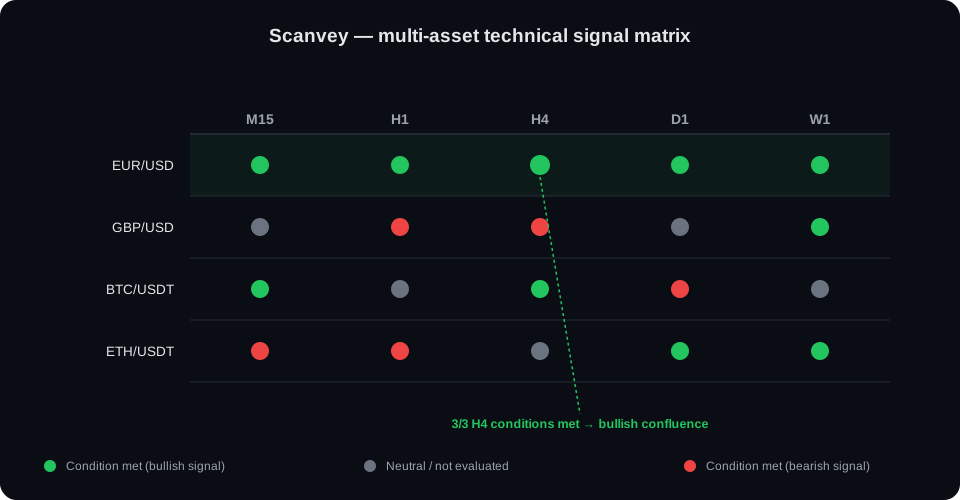
The solution is to replace this sequential workflow with a signal matrix — a visual grid that shows, at a glance, which pair/timeframe combinations currently have confirmed conditions.
Instead of checking 50 combinations manually, you see them all simultaneously. Green cells mean all your conditions are met. Orange cells mean some conditions are met. Red means none. Grey means insufficient data.
This visual density allows you to do in 5 seconds what previously took 45 minutes: identify which setups deserve closer attention. You go from scanning to analyzing — only the cells that show signals get your full attention.
The key insight: Multi-timeframe analysis does not require more time. It requires better tools. The analysis itself takes seconds once the data is organized correctly.
Scanvey is built around exactly this concept. It aggregates forex and crypto data across M15, H1, H4, D1, and W1 in real time, calculates moving averages, RSI, MACD, and Ichimoku values, and presents the results in a matrix you can scan in seconds. You define the conditions that matter to your strategy — and the matrix highlights every pair and timeframe where those conditions are currently met.
Building Your Multi-Timeframe Trading Routine
A structured daily routine ensures that MTA becomes a habit rather than an afterthought.
Pre-Session Review (15–20 minutes)
Before the trading session begins:
- Weekly chart review — Has anything changed structurally since last week? Are there major levels being tested?
- Daily chart scan — What is the current trend for each pair you trade? Any overnight breaks of key levels?
- H4 context — Where is price within the daily trend? Continuation or potential reversal?
This pre-session review sets your bias for the day. You know, before the market opens, which pairs you are bullish on, which you are bearish on, and which you are neutral on.
During-Session Monitoring
During the session, you are waiting for your pre-identified setups to develop:
- Check H1 every hour for entry zones being tested
- Check M15 only when price is in an H1 entry zone
- Do not chase price — let the setup come to you
Post-Session Journal
At the end of each session:
- Record every trade: entry, exit, timeframes used, conditions met
- Note any setups you missed and why
- Identify if your pre-session bias was correct
Over time, your journal will reveal which timeframe combinations produce the best results for your specific pairs and strategy.
Multi-Timeframe Analysis for Crypto
Multi-timeframe analysis applies equally to crypto markets, with a few important adaptations:
Markets never close. Unlike forex, crypto trades 24/7. This means that "daily" and "weekly" candles are formed differently — there is no overnight gap, and weekend volatility is often significant. Your H4 and D1 analysis needs to account for weekend price action that may not be present in forex.
Higher volatility requires wider zones. The entry zones you define on H1 and M15 for crypto should be wider than for forex. Bitcoin can move 3–5% in a single H1 candle — what looks like a tight entry zone on EUR/USD may be far too narrow for BTC/USDT.
Correlation matters more. In crypto, most altcoins are highly correlated with Bitcoin. Before analyzing ETH/USDT or SOL/USDT on a timeframe-by-timeframe basis, check the BTC/USDT trend first. A bearish Bitcoin on D1 will pull most altcoins down regardless of their individual setups.
Key timeframes for crypto:
| Timeframe | Use Case |
|---|---|
| W1 | Macro cycle analysis — bull/bear market phase |
| D1 | Primary trend — most reliable for entries |
| H4 | Intermediate swing trading |
| H1 | Intraday momentum confirmation |
| M15 | Entry timing for shorter-term positions |
The methodology is identical — start from W1/D1, work down to M15. The only adaptation is position sizing relative to higher crypto volatility.
A Note on Patience: The Scarcest Trading Resource
Multi-timeframe analysis reveals something uncomfortable: truly high-quality setups are rare.
When you require 3/3 timeframe alignment AND multiple indicator confluence, you will find that on any given day, most pairs have no setup worth trading. This is not a bug — it is a feature.
The temptation to trade suboptimal setups — because you have been watching the market for two hours and need to "do something" — is one of the most destructive forces in retail trading. MTA provides a framework that makes suboptimal setups visible as suboptimal. When only 1 of 3 timeframes is aligned, the matrix shows you a partial signal. The discipline to not trade that signal is what separates professionals from amateurs.
Rule: If you cannot immediately identify which timeframe first gave you the signal and confirm that the two higher timeframes support it, do not trade.
The forex market is open 5 days a week, 24 hours a day. Crypto never closes. There will always be another setup. The traders who preserve capital through disciplined inaction are the ones still trading five years from now.
Summary: The Multi-Timeframe Analysis Checklist
Before entering any trade, run through this checklist:
Higher timeframe (W1 / D1):
- MA10 above or below MA200 — confirms trend regime
- RSI above or below 50 — confirms momentum regime
- MACD line above or below signal — confirms momentum direction
Intermediate timeframe (H4):
- MA alignment consistent with D1?
- RSI consistent with D1?
- Price structure (higher highs/lows) consistent with D1?
Entry timeframe (H1):
- Price in identified entry zone?
- At least 2 of 3 indicators (MA, RSI, MACD) aligned?
Execution timeframe (M15):
- At least 2 trigger signals present (MA crossover, MACD cross, RSI recovery)?
If you cannot check at least 8 of 10 boxes: do not trade.
Conclusion
Multi-timeframe analysis is not a strategy — it is a framework that makes any strategy more rigorous. It forces you to think about market context before thinking about entries. It filters noise. It aligns your trades with the dominant institutional flow. And it gives you a clear, objective process for evaluating any setup across any asset.
The traders who master MTA share a common characteristic: they spend far more time not trading than trading. They wait for alignment. They wait for confluence. And when it arrives, they act decisively, because they have done the work.
The challenge has always been execution at scale. Checking 10 pairs across 5 timeframes manually, multiple times per day, is simply not sustainable for most traders. A visual matrix that aggregates these conditions across all your pairs and timeframes — updated in real time — eliminates that bottleneck and allows you to focus on what matters: the decision.
If you want to apply multi-timeframe analysis across forex and crypto without spending hours on manual scanning, Scanvey was built for exactly that use case. Set your conditions once, and let the matrix show you where they are met — across every pair and every timeframe, simultaneously.
Related articles:
- Top-Down Analysis in Forex Trading
- Best Timeframes for Forex Trading
- Technical Indicators Combination Guide
- Forex Confluence Trading
Frequently asked questions
What is multi-timeframe analysis in forex?
Multi-timeframe analysis means examining the same currency pair or asset across several different chart intervals — typically at least three — before making any trading decision. The standard approach starts with a higher timeframe (weekly or daily) to establish trend direction and key levels, moves to an intermediate timeframe (H4 or H1) to identify the entry zone, and finishes on a lower timeframe (H1 or M15) to time the entry precisely. Each timeframe provides context for the one below it.
Which timeframes should I combine for multi-timeframe analysis?
The most common and effective combination for forex swing trading is W1 (macro regime) + D1 (trend direction and levels) + H4 (entry zone) + H1 (entry timing). For traders with less time, D1 + H4 + H1 is the minimum viable combination. Day traders often use H4 + H1 + M15. The principle is consistent regardless of the specific timeframes: always have at least one timeframe above and one below your primary trading timeframe to provide context and precision.
Does multi-timeframe analysis work for crypto as well as forex?
Yes — multi-timeframe analysis works on any liquid asset with sufficient price history. For crypto, the timeframe weighting shifts slightly: the weekly chart carries more importance for Bitcoin and Ethereum than it does for forex, because Bitcoin's four-year halving cycle creates macro patterns that are most visible on the weekly chart. The methodology is identical; the calibration and timeframe emphasis differ from forex to reflect crypto's distinct market structure.
How do I start multi-timeframe analysis if I am new to it?
Start with just two timeframes: a higher one (D1) for trend direction and a lower one (H4) for entry timing. Establish a simple rule: only take long trades when D1 is in an uptrend, only take short trades when D1 is in a downtrend. Use H4 indicators for entry signals within that D1 context. Once this two-timeframe discipline is consistent, add a third timeframe for additional precision. Building the habit of checking the higher timeframe first is more important initially than optimising which specific timeframes to use.
Further reading
These reference resources complement the analysis presented in this article:
Related reading
Align your timeframes in one click
W1, D1, H4, H1 and M15 shown side by side for every asset, no chart-switching required.
Try the multi-timeframe scannerThis article is for informational and educational purposes only. It does not constitute investment advice or a trading signal. Trading financial products involves a high risk of capital loss. Full risk disclaimer