Best Timeframes for Forex Trading
M15, H1, H4, D1 or W1 — which timeframe fits your strategy? A practical breakdown of each timeframe's strengths and ideal use cases.
Published on 4 June 2026
One of the first decisions every forex trader makes — and one of the most consequential — is choosing a timeframe. Get it wrong and you spend hours analyzing noise. Get it right and your signals become clearer, your entries more precise, and your risk management more coherent.
The challenge is that there is no universally "best" timeframe. The right choice depends on how much time you can dedicate to the market, your risk tolerance, and your trading style. What works for a full-time trader monitoring screens all day will destroy a professional who can only check charts twice daily.
This guide breaks down every major forex timeframe — M15, H1, H4, D1, and W1 — with honest assessments of each, and a framework for choosing the right one for your situation.
Why Timeframe Choice Matters More Than Indicator Choice
Most new traders spend weeks debating which indicator to use. Few spend enough time thinking about which timeframe to trade. This is backwards.
Your timeframe determines:
- How much noise you see — Lower timeframes contain more random price movement that has no predictive value
- How often you get signals — M15 generates dozens of setups per day; D1 might generate one per week per pair
- How long you need to be right — A D1 trade needs to work over days; an M15 trade needs to work in minutes
- Your psychological exposure — Lower timeframes require constant attention and create more emotional pressure
The indicator you use matters far less than the timeframe you apply it on. A 200-period moving average on D1 is one of the most powerful technical tools in forex. The same moving average on M5 is close to useless.
Core principle: Match your timeframe to your lifestyle first, your strategy second. No trading edge survives a trader who cannot consistently monitor their chosen timeframe.
The Five Core Timeframes
M15 (15 Minutes) — Fast Signals, High Discipline Required
Signals per day: 5–20 per pair | Holding time: 15 min – 3 hours | Noise level: High
The M15 is the shortest timeframe most serious traders use for decision-making. Below M15, price action becomes dominated by market microstructure — spread effects, liquidity gaps, and algorithmic activity — rather than genuine supply and demand.
What M15 does well:
- Provides precise entry timing within a setup identified on higher timeframes
- Allows tight stop losses, improving theoretical risk-to-reward ratios
- Works well for scalping during high-liquidity sessions (London open, New York open)
What M15 does poorly:
- Generates a high number of false signals — most M15 "setups" fail when viewed in context
- Requires near-constant monitoring during the trading session
- Moving average crossovers on M15 have poor predictive reliability without higher-timeframe confirmation
- Spread costs consume a larger percentage of profit per trade
Who M15 is for: Traders who can actively monitor the market during a specific 2–4 hour window (typically London open or NY open), who use it exclusively for entry timing rather than trend analysis.
Key warning: Never use M15 for trend analysis. It is an execution timeframe only. Always require H1 or H4 confirmation before acting on an M15 signal.
H1 (1 Hour) — The Active Trader's Sweet Spot
Signals per day: 2–8 per pair | Holding time: 2 – 12 hours | Noise level: Moderate
The 1-hour chart occupies a productive middle ground between the noise of M15 and the slow-moving nature of H4. It is widely considered the best timeframe for active traders who can check charts a few times per day.
What H1 does well:
- Clean enough for meaningful technical analysis — moving averages, RSI, and MACD all produce actionable signals
- Fast enough to generate multiple setups per week on any given pair
- Manageable holding periods — most H1 trades resolve within the same trading day or the next
- Works well with the natural rhythm of forex sessions (Asian, London, New York)
What H1 does poorly:
- Still susceptible to news event spikes that can stop out technically sound setups
- Requires checking the market every 1–3 hours to manage open positions actively
- Signals are less reliable without H4 and D1 confirmation
Who H1 is for: Active traders who can check markets 4–6 times per day and want a balance between signal frequency and signal quality. H1 works best as the entry zone identification timeframe, with M15 for execution and H4/D1 for direction.
H4 (4 Hours) — The Professional Standard
Signals per week: 3–10 per pair | Holding time: 1 – 5 days | Noise level: Low to moderate
The 4-hour chart is where many professional and institutional traders operate. It filters out the intraday noise that plagues lower timeframes while still providing enough data points to identify meaningful trends and setups within a week.
What H4 does well:
- Technical indicators are highly reliable — MA crossovers, RSI signals, and MACD divergences on H4 have strong track records
- Holding periods are manageable without requiring overnight position anxiety every night
- Major support and resistance levels on H4 are respected consistently by the market
- Only requires chart checks 2–3 times per day
What H4 does poorly:
- Lower signal frequency means more patience required — some weeks produce few quality setups
- Overnight gaps (weekend gaps in particular) can be significant and affect open positions
- Stop losses are wider than on lower timeframes, requiring larger account size for proper risk management
Who H4 is for: Traders who want professional-quality signals without being glued to a screen. H4 is ideal as the primary analysis timeframe, with D1 for macro context and H1/M15 for entry precision.
The H4 advantage: H4 is slow enough to filter noise and fast enough to remain actionable. Most institutional technical analysis frameworks are built around the daily and 4-hour charts.
D1 (Daily) — The Swing Trader's Foundation
Signals per week: 1–4 per pair | Holding time: 3 – 15 days | Noise level: Very low
The daily chart is the anchor of multi-timeframe analysis. It represents an entire trading day's activity in a single candle, filtering out all intraday noise and showing you only the significant directional moves that matter.
What D1 does well:
- The highest signal reliability of any timeframe — daily MA alignments, RSI readings, and MACD signals are the most consistent in forex
- Only requires 15–20 minutes of chart analysis per day
- Trends on D1 persist for weeks to months, giving wide profit potential
- No screen monitoring required during the day — check the chart after the daily close
- The MA200 on D1 is one of the most respected technical levels in the entire market
What D1 does poorly:
- Very low signal frequency — weeks can pass without a high-quality setup on a given pair
- Wide stop losses require sufficient account capital
- Requires psychological resilience to hold positions through multi-day retracements without closing prematurely
Who D1 is for: Swing traders, part-time traders, and professionals who cannot monitor markets during the day. D1 is also the primary trend direction timeframe for any multi-timeframe analysis approach regardless of the execution timeframe you use.
W1 (Weekly) — The Macro Context Setter
Signals per month: 1–3 per pair | Holding time: Weeks to months | Noise level: Minimal
The weekly chart is not a trading timeframe for most retail traders — it is a context timeframe. Few retail traders hold positions for multiple weeks, but every retail trader should look at the weekly chart before making any trade decision.
What W1 does well:
- Reveals the dominant macro trend that all lower timeframes operate within
- Identifies major structural support and resistance levels that have held for months or years
- Moving averages on W1 (particularly MA10 and MA200) define the long-term trend regime
- Eliminates analysis paralysis by giving a clear "big picture" direction
What W1 does poorly:
- Too slow for active trading — most retail setups play out before a weekly candle closes
- Stop losses would be enormous if trading directly from W1 signals
Who W1 is for: Every trader, as a context timeframe. Open the weekly chart first, establish the macro bias, then drill down to your trading timeframe. This takes 2 minutes and can prevent you from trading against a powerful trend you were not aware of.
Checking this W1-to-M15 hierarchy manually across a full watchlist means opening five charts per pair, every session. In Scanvey, the same five timeframes are laid out side by side for every pair at once — the weekly bias, the daily trend, and the faster triggers are all visible in a single view, so the drill-down described above takes seconds instead of minutes per pair.
Comparing the Timeframes
| Timeframe | Signal Frequency | Reliability | Screen Time Needed | Account Size Required | Best Use |
|---|---|---|---|---|---|
| M15 | Very high | Low | High (active) | Small | Entry execution |
| H1 | High | Moderate | Medium | Small-Medium | Entry zone |
| H4 | Moderate | High | Low | Medium | Primary analysis |
| D1 | Low | Very high | Very low | Medium-Large | Trend direction |
| W1 | Very low | Highest | Minimal | Large | Macro context |
How to Choose Your Primary Trading Timeframe
Answer these four questions honestly:
1. How much time can you dedicate to trading each day?
- Less than 30 minutes → D1 only
- 30–60 minutes, once or twice daily → H4 primary, D1 context
- 2–3 hours, during specific sessions → H1 primary, H4 confirmation
- Full-time, market hours → H1 or M15 execution with H4/D1 direction
2. What is your account size?
Stop losses on D1 trades are often 80–150 pips. On H4, typically 40–80 pips. On H1, 20–40 pips. Proper risk management requires that no trade risks more than 1–2% of your account. If your account cannot support D1 stop losses at 1% risk per trade, drop to H4 or H1.
3. How emotionally stable are you during drawdowns?
Lower timeframes generate more trades and more frequent small losses. Higher timeframes generate fewer trades but the losses are larger in pip terms when they occur. Some traders handle frequent small losses better; others handle infrequent larger losses better. Know yourself.
4. Are you a trend follower or a mean-reversion trader?
Trend followers should bias toward H4 and D1, where trends are clearest. Mean-reversion traders can work effectively on H1 and M15, where temporary extremes are more frequent and recoverable.
The Multi-Timeframe Approach: The Best of All Timeframes
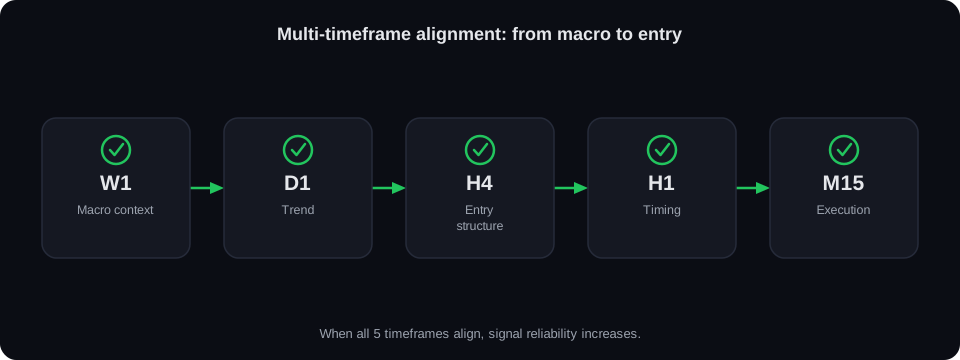
The most robust approach is not to choose one timeframe — it is to use multiple timeframes in a coordinated way. This is the basis of multi-timeframe analysis:
- W1 / D1 → Macro bias and trend direction. See daily chart forex analysis for a deeper look at how to structure your D1 workflow.
- H4 → Intermediate structure and entry zone. The H4 trading strategy guide covers how to build entries specifically around this timeframe.
- H1 → Entry zone confirmation
- M15 → Precise entry timing
Each timeframe serves a different purpose in the decision-making chain. None of them alone is sufficient; together, they give you the full picture.
The practical challenge is monitoring all five timeframes for multiple pairs simultaneously — which is why tools that automate this scanning are increasingly essential for traders following this methodology.
Whatever timeframe you trade on, checking indicator alignment across your entire watchlist for that timeframe is a significant time cost when done manually. Scanvey solves this — it scans all pairs across M15, H1, H4, D1, and W1 simultaneously and shows you at a glance which pairs have the conditions aligned for your chosen timeframe, so you spend your time on analysis rather than on data gathering.
Common Timeframe Mistakes to Avoid
Timeframe hopping: Switching between timeframes after a trade goes against you, looking for a timeframe that confirms your original bias. This is post-hoc rationalization, not analysis. Decide your timeframe before you enter, and stay with it.
Using too many timeframes: Checking seven timeframes creates contradiction and paralysis. Three is the standard maximum: one for macro context, one for analysis, one for execution.
Matching the wrong timeframe to your schedule: Trading M15 when you can only check charts once per day is a guarantee of mismanaged trades. Your timeframe must fit your availability, not your ambition.
Ignoring the daily chart: No matter what your primary trading timeframe is, you should know the D1 direction before you enter any trade. Trading H1 against a confirmed D1 trend is one of the most common causes of avoidable losses. The discipline of always checking higher timeframes first is the foundation of top-down analysis in forex.
Conclusion
There is no universally best forex timeframe. There is only the best timeframe for you — based on your available time, account size, psychological profile, and trading goals.
If you are starting out and unsure: begin with H4 and D1. These two timeframes offer the best balance of signal reliability, required screen time, and technical clarity. As you develop consistency, you can add H1 for entry precision and W1 for context.
Whatever timeframe you choose, do not use it in isolation. Check at least one higher timeframe for direction before every trade. A D1 check before an H4 entry takes two minutes. That two minutes can be the difference between trading with the trend and trading against it.
Related articles:
- Multi-Timeframe Analysis: The Complete Guide
- H4 Trading Strategy Guide
- Daily Chart Forex Analysis
- Top-Down Analysis in Forex
Frequently asked questions
What is the best timeframe for forex day trading?
H1 is the most practical timeframe for forex day trading for most retail traders — it generates enough setups to stay active without the noise and constant screen time of M15. Many day traders use H1 to identify the setup structure and M15 to time entries precisely. Using D1 or H4 for directional bias before executing on H1 significantly improves signal reliability.
Should I use D1 or H4 for swing trading?
Both — used together. D1 defines the macro trend direction and identifies the key levels where price is likely to find support or resistance. H4 is where you look for entry structure once price approaches those D1 levels. D1 alone gives too few precise entry points; H4 alone lacks the macro context to filter high-quality setups from poor ones.
Which timeframe do professional forex traders use most?
Most institutional and professional retail traders anchor their analysis on the H4 and D1 charts. These timeframes offer the best balance of signal reliability and actionability — signals are meaningful enough to trade confidently, and they occur frequently enough to sustain consistent activity. The W1 chart is used for macro context but not for direct entries.
Can I trade forex using only the daily chart?
Yes — and for part-time traders with limited screen time, D1-only trading is a legitimate and often underrated approach. Daily signals are the most reliable in forex, stop losses are logically sized, and the workflow requires only 15–20 minutes of analysis per day after the daily close. The trade-off is signal frequency: some pairs may produce only two or three quality setups per month on D1, which requires patience and a suitable account size for wider stops.
What timeframe should complete beginners start with?
D1 is the most forgiving starting point. It has the lowest noise-to-signal ratio of any timeframe, only requires checking the chart once a day, and its slower pace gives beginners time to think through a decision rather than reacting under pressure. H4 is a reasonable second step once basic pattern recognition feels comfortable.
Further reading
These reference resources complement the analysis presented in this article:
Related reading
Reference guide for this topicMulti-Timeframe Analysis: The Complete Forex & Crypto Guide
Align your timeframes in one click
W1, D1, H4, H1 and M15 shown side by side for every asset, no chart-switching required.
Try the multi-timeframe scannerThis article is for informational and educational purposes only. It does not constitute investment advice or a trading signal. Trading financial products involves a high risk of capital loss. Full risk disclaimer