How to Scan Forex Pairs Efficiently
A systematic approach to scanning 20+ forex pairs across multiple timeframes — the exact daily process professionals use to spot setups.
Published on 4 June 2026
The forex market offers dozens of tradeable pairs. Scanning them manually — pair by pair, timeframe by timeframe — is how most traders waste an hour every morning before placing a single trade.
There is a better way.
Professional traders do not open every chart and assess it from scratch. They use a structured, hierarchical scan process that eliminates irrelevant pairs quickly, filters for directional alignment automatically, and focuses manual analysis on the small number of pairs where a genuine setup might be developing. The entire scan takes 15–20 minutes. The remaining analysis time is spent exclusively on the three or four pairs worth examining in depth.
This guide breaks down the exact process: how to build a watchlist, how to run the scan, what to look for at each stage, and how to use tools to compress the repetitive parts into minutes rather than hours. For the specific trend, momentum, and exclusion conditions referenced throughout — the actual criteria this process checks — see forex scanning criteria. If the concept of a scanner itself is new to you, What Is a Forex Scanner and How Does It Work? covers the basics first.
Why Most Traders Scan Inefficiently
The typical approach to scanning goes something like this: open EUR/USD, look at it for five minutes, feel uncertain, move on to GBP/USD, look at that for five minutes, check USD/JPY, notice something interesting on EUR/GBP, go back to EUR/USD… Twenty pairs and ninety minutes later, the trader has a vague sense of which pairs "feel interesting" and no systematic framework for comparing them.
The problems with this approach are structural:
It is not reproducible. The results depend on attention level, order of analysis, and subjective impressions that vary day to day. Two traders running the same process arrive at different conclusions.
It rewards recency bias. The last pair analysed tends to look most compelling simply because it is freshest in mind. The first pair analysed may have had the best setup, but it has been mentally displaced by everything seen since.
It misses correlated pair opportunities. Without a systematic overview, it is easy to enter EUR/USD and GBP/USD simultaneously — effectively doubling your USD exposure — without realising it.
It wastes time on irrelevant charts. A pair in a clear D1 downtrend with no bullish setups visible is analysed for five minutes anyway, because the process provides no quick filter to eliminate it early.
A structured scan process solves all four problems.
| Step | Action | Tool / Indicator | Validation Threshold | Time |
|---|---|---|---|---|
| 1 | D1 regime classification | MA50 vs MA200 | Clear bull/bear alignment | 5 min |
| 2 | Momentum confirmation | RSI above/below 50 | Consistent with MA bias | 2 min |
| 3 | Identify key levels | Swing highs/lows, MA200 | 2+ confluent levels visible | 5 min |
| 4 | H4 structure check | MA10/MA50, MACD | H4 aligns with D1 bias | 3 min |
| 5 | Entry trigger watch | Candle pattern at level | Pin bar or engulfing at S/R | At setup |
Step 1 — Define Your Watchlist
Before scanning, you need a defined watchlist. Scanning everything every day is neither practical nor necessary.
A well-constructed forex watchlist for swing trading contains 15–25 pairs, organised into tiers:
Tier 1 — Major pairs (8 pairs): EUR/USD, GBP/USD, USD/JPY, USD/CHF, USD/CAD, AUD/USD, NZD/USD, EUR/GBP. These have the highest liquidity, tightest spreads, and most reliable technical behaviour. They should be on every scan.
Tier 2 — Cross pairs (8–12 pairs): EUR/JPY, GBP/JPY, EUR/AUD, GBP/AUD, AUD/JPY, CAD/JPY, EUR/CAD, GBP/CAD, and similar. These pairs offer additional setups when major pairs are in consolidation. They tend to trend strongly when there is clear divergence between the two underlying currencies, but can be more volatile and less technically clean.
Tier 3 — Situational pairs (2–5 pairs): Pairs you add temporarily based on current macro themes. If the Bank of Japan is expected to hike rates, all JPY crosses belong in the active watchlist. Once the theme fades, they drop back out.
Keep your full watchlist stable — do not add or remove pairs reactively based on yesterday's move. Review and adjust it monthly, not daily.
Step 2 — The D1 Regime Scan (5 minutes)
The first pass through your watchlist is a rapid D1 regime classification. For each pair, you are answering a single question: is this pair in a bullish regime, bearish regime, or no-regime (ranging)?
The three-condition regime check on D1:
- MA50 above MA200 = bullish; below = bearish; intertwined = ranging
- RSI above 50 = bullish momentum; below = bearish; oscillating near 50 = ranging
- Price above MA200 = bullish macro; below = bearish
If all three conditions agree, classify the pair as clearly bullish or clearly bearish. If they disagree or are mixed, classify as ranging or transitional.
Running this check takes roughly 15–20 seconds per pair once you are familiar with it. For a 20-pair watchlist, that is under seven minutes. The result is a classified list:
- Clearly bullish: EUR/USD, AUD/USD, EUR/JPY, GBP/JPY
- Clearly bearish: USD/JPY, USD/CHF, EUR/CHF
- Ranging/transitional: GBP/USD, USD/CAD, NZD/USD, AUD/JPY, and others
You are only looking for setups in the direction of the regime. Bullish pairs get analysed for long setups only. Bearish pairs for short setups only. Ranging pairs are set aside unless you have a specific range-trading process.
This single step typically eliminates 40–60% of your watchlist from further analysis in any given session.
The three-condition check above still means opening every pair once. Scanvey runs the same MA50/MA200, RSI, and price-vs-MA200 conditions continuously across all 30 covered pairs, so the classified list described above — bullish, bearish, ranging — is already built before you open a single chart.
Step 3 — The H4 Confluence Filter (5 minutes)
From your classified list, take only the clearly bullish and clearly bearish pairs and run a second pass on H4.
For each remaining pair, check:
- Is H4 MA alignment consistent with the D1 regime? (H4 MA50 above MA200 for bullish pairs)
- Is H4 RSI confirming the direction? (Above 50 for bullish pairs)
- Is price approaching or at a significant H4 level? (Key support for longs, resistance for shorts)
Pairs where H4 confirms the D1 regime AND price is near a key level move to the shortlist. Pairs where H4 confirms D1 but price is mid-range — not near any significant level — are noted as "directional but no setup forming yet." Check them again tomorrow.
After this second pass, your list of pairs worth deep analysis has typically shrunk to three to six pairs.
Step 4 — Deep Analysis on Shortlisted Pairs (10 minutes)
For the three to six shortlisted pairs, run the full analysis:
Level validation: Is the key H4 level genuinely significant? How many times has it been tested? Is it a prior swing high/low, an MA level, or a consolidation zone? The more tests and the cleaner the structure, the higher the confidence.
Indicator confluence score: Run the full confluence check — RSI, MACD, Ichimoku, MA alignment — on both D1 and H4. Score the setup (see the confluence trading framework in the related article). Only setups scoring 6/10 or higher move forward.
Entry pattern watch: Is there a current entry candle forming, or are you waiting for one? If the H4 candle is mid-way through its four-hour period, note what you need to see at the close. Set a reminder for the candle close time.
Correlated pair check: Before finalising, check whether you already have a position in a correlated pair. Planning to go long EUR/USD and EUR/GBP simultaneously both expresses EUR strength — one position may be sufficient. Planning to go long EUR/USD and short USD/CHF is essentially the same trade twice — be aware of the doubled exposure.
This deep analysis is where the quality of your trading decisions is made. Everything before this step was filtering. This step is judgment.
Step 5 — Post-Scan Documentation
After completing the scan, write down your conclusions in a simple trading log:
- Pairs in bullish regime: [list]
- Pairs in bearish regime: [list]
- Setups approaching key levels: [list with levels]
- Active watches (waiting for entry candle): [list with candle close time]
- Setups entered today: [if any, with entry, stop, target]
This documentation takes three minutes and is invaluable for three reasons. First, it prevents you from forgetting a setup you identified during the scan. Second, it forces explicit commitment to your analysis — a written "I am watching EUR/USD for a long at 1.0855" is harder to abandon impulsively than a vague mental note. Third, it creates a record you can review weekly to assess whether your scanning process is identifying the right setups.
The Correlated Pairs Problem
One of the most significant risks in scanning multiple pairs is inadvertently building correlated exposure without realising it.
The major forex pairs all involve USD as either the base or quote currency. When the dollar moves, all USD pairs move simultaneously. If your scan identifies bullish setups on EUR/USD, AUD/USD, and NZD/USD simultaneously, you are effectively making a single bet — that USD will weaken — three times over. If that bet is wrong, all three positions lose at once.
The solution is to classify setups by their underlying currency exposure:
USD short exposure: Long EUR/USD, AUD/USD, GBP/USD, NZD/USD; Short USD/JPY, USD/CHF, USD/CAD EUR long exposure: Long EUR/USD, EUR/JPY, EUR/GBP, EUR/AUD, EUR/CAD JPY long exposure: Short USD/JPY, EUR/JPY, GBP/JPY, AUD/JPY, CAD/JPY
From each currency exposure category, take at most one or two positions. If six pairs all point to USD weakness, pick the one or two with the highest confluence score and pass on the rest.
This discipline keeps your portfolio genuinely diversified rather than superficially diversified across many pairs that are all expressing the same macro view.
Timeframe-Specific Scanning Considerations
Different timeframes require different scanning frequencies.
D1 swing traders: One scan per day, ideally after the daily candle closes (22:00–23:00 UTC). The D1 candle close is the most important event in your trading day. Everything else is noise.
H4 swing traders: Three to four scans per day, at or shortly after each H4 candle close: 04:00, 08:00, 12:00, 16:00 UTC. The 08:00 and 12:00 UTC closes (London open and NY pre-open) are the most significant — these candles capture the most directional session activity and produce the most reliable H4 signals.
H1 traders: Continuous monitoring during active sessions, with the emphasis on the London open (08:00–10:00 UTC) and New York open (13:00–15:00 UTC). See how to scan forex before major sessions for a dedicated pre-open checklist.
For most swing traders, H4-based scanning is the practical sweet spot. It requires active attention for a limited part of the day, captures meaningful directional moves, and produces signals that are reliable enough to act on without constant second-guessing.
Using Scanning Tools to Compress the Process
The first three steps of the scanning process — D1 regime classification, H4 confluence filter, and level proximity check — are largely mechanical. They involve checking the same indicator conditions across many pairs. This is exactly the kind of work that scanning tools are designed to compress — see the manual vs automated scanning breakdown for a full comparison.
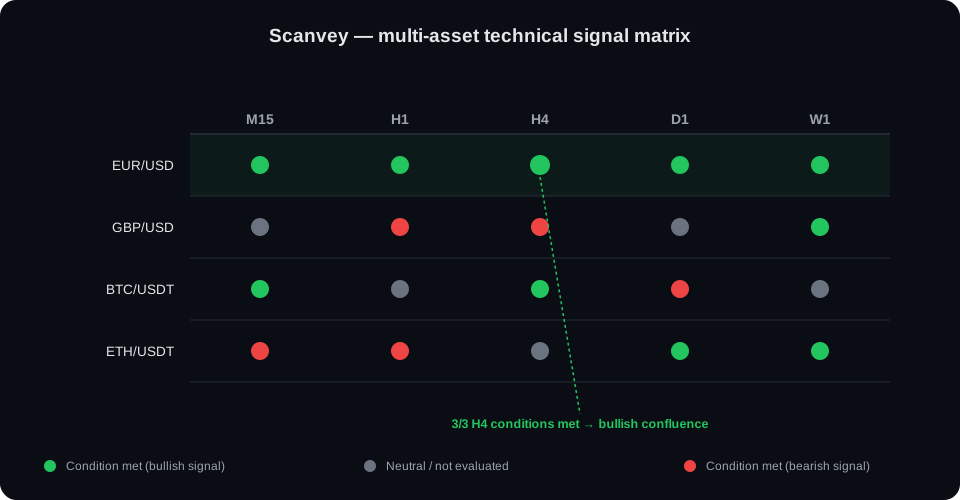
Scanvey displays a matrix view of indicator conditions for all pairs across all timeframes simultaneously. Instead of opening EUR/USD, checking MA alignment, closing it, opening GBP/USD, checking MA alignment — and repeating this twenty times — you see the conditions for all pairs on a single screen.
The matrix shows, at a glance, which pairs have MA crossover conditions active, which have RSI above or below 50, which have MACD confirming a direction, and which have Ichimoku cloud alignment — all per timeframe. The D1 regime scan that takes five minutes manually takes under thirty seconds with a matrix view: you scan a column, not twenty charts.
This compression changes the economics of scanning fundamentally. When the mechanical steps are automated, the time and cognitive budget that remains goes entirely to the judgment-intensive steps — level validation, confluence scoring, entry pattern assessment — where human analysis actually adds value.
The practical result: the complete scan process — which follows the same multi-timeframe hierarchy described in the complete MTA guide — takes 15–20 minutes manually, takes 8–10 minutes with tool support. More importantly, the quality of the deep analysis improves because you arrive at it less fatigued by the mechanical steps.
Building the Habit: Weekly and Monthly Reviews
A daily scan process is the operational layer. The strategic layer is the weekly and monthly review.
Weekly review (30 minutes, end of week): Review your trading log from the week. Which pairs produced setups? Which setups triggered? Which worked, which failed? Were there pairs you analysed in depth but passed on — should you have traded them? This review calibrates your process over time.
Monthly watchlist review (15 minutes): Reassess your Tier 2 and Tier 3 pairs. Are the cross pairs you added three months ago still trending actively, or have they entered prolonged ranges? Are there new macro themes that justify adding pairs temporarily? Remove inactive pairs to keep the watchlist sharp.
The combination of daily scanning discipline and regular review creates a feedback loop that continuously improves the quality of your analysis. You become better at recognising which pairs are worth deep analysis and which are wasting your time — and faster at both judgments.
Conclusion
Efficient forex scanning is a learnable skill, and it follows a clear structure: classify regimes on D1, filter for H4 alignment, deep-analyse the shortlisted pairs, document findings. The process is systematic, reproducible, and time-bounded — characteristics that reactive, chart-by-chart scanning entirely lacks.
The tools available today make the mechanical steps of this process significantly faster. The judgment steps — assessing level quality, evaluating confluence, reading entry candles — remain human work. The goal is to get through the mechanical steps quickly enough that you arrive at the judgment steps with full attention rather than depleted focus.
Build the scan process as a daily habit. Run it at the same time each day, document the results, and review them weekly. Within a few months, you will know your watchlist pairs so well that the regime classification is almost instantaneous and the deep analysis is focused on genuinely meaningful decisions.
That is the scanner's edge — not speed, but systematic clarity.
Related articles:
- Forex Scanning Criteria: What to Look For Before You Trade
- Manual vs Automated Forex Scanning
- Forex Confluence Trading: How Multiple Signals Work
- The Ultimate Forex Trading Checklist
- Multi-Timeframe Analysis: The Complete Guide
Frequently asked questions
How long should a complete forex market scan take?
A well-structured manual scan of a 10–15 pair watchlist across four timeframes takes 15–20 minutes. If it is taking longer, the process is not hierarchical enough — most pairs should be eliminated quickly in the D1 regime check, with only 3–5 pairs making it to the deep analysis stage. With a matrix scanning tool that automates the indicator checks, the total time drops to 8–10 minutes, with more of that time spent on the judgment-intensive steps.
How do professional traders scan multiple forex pairs efficiently?
Professional traders use a top-down, hierarchical process: start with the weekly chart to identify macro regime for each pair, move to the daily chart to identify trend and key levels, then use H4 to identify whether a setup is forming at those levels. This eliminates most pairs quickly and concentrates analytical time on the 2–4 pairs where conditions are actually aligned. The process is reproducible and takes the same amount of time whether markets are active or quiet.
What is the most efficient way to scan 20+ forex pairs?
A matrix scanner is the most efficient solution for large pair universes. Instead of opening each pair's chart individually and checking indicator conditions one by one, a matrix view displays the conditions for all pairs across all timeframes simultaneously. This reduces the initial screening phase from 30–45 minutes to under two minutes, allowing the remaining time to be spent on the detailed chart analysis that actually requires human judgment.
Should I scan all pairs every day or only my watchlist?
Scan your defined watchlist daily — this is your operational process. Run a broader universe scan monthly to check whether pairs outside your current watchlist have entered trending conditions that warrant adding them. The daily scan should be fast and focused; the monthly universe review is the time to assess whether the watchlist itself needs updating.
How do I know if my scanning process is actually working?
Consistency is the better signal, not the outcome of any single scan. If the same top-down process reliably surfaces two to four genuine setups per week without requiring adjustments to the criteria, it is working. If you find yourself repeatedly loosening the D1 regime filter or the H4 confluence requirement to generate more candidates, the process is being bent to manufacture setups rather than to find them — a sign to tighten the criteria back up rather than trust the output.
Further reading
These reference resources complement the analysis presented in this article:
Related reading
- Forex Scanner for Swing Trading
- Forex Scanner vs Forex Screener: What's the Difference?
- Forex Scanning Criteria: What to Look For Before You Trade
- How to Filter Forex Pairs Using RSI
- How to Rank Forex Pairs Before Opening Your Charts
- How to Detect MACD Crossovers Across Multiple Forex Pairs
- How to Scan Forex Before Major Sessions
- What Is a Forex Scanner and How Does It Work?
- Best Forex Pairs for Technical Analysis
- How to Build a Focused Forex Watchlist
- Manual vs Automated Forex Scanning: Which Is Better?
Scan your forex pairs in real time
See at a glance where your technical conditions align, across 30 pairs and 5 timeframes.
Try the forex scannerThis article is for informational and educational purposes only. It does not constitute investment advice or a trading signal. Trading financial products involves a high risk of capital loss. Full risk disclaimer