Moving Average Crossover: Complete Forex Guide
Use moving average crossovers in forex: best settings per timeframe, how to filter false signals, and combining crossovers with trend tools for better entries.
Published on 4 June 2026
Buy when the fast average crosses above the slow one, sell when it crosses below: it is the oldest rule in technical analysis, and one of the easiest to apply badly.
Every trader has encountered the concept. The logic is intuitive, the implementation is simple, and the backtests often look compelling — which is precisely why so many traders apply the signal mechanically, get caught by its limitations, and either blame the indicator or abandon it entirely.
The moving average crossover is not a complete strategy. It is a momentum signal that performs well in specific market conditions and poorly in others. Understanding which conditions favour it, which MA combinations to use, how to filter false signals, and how to combine crossovers with the rest of a technical framework is what separates traders who profit from it from those who do not. For the concept of scanning this condition across a watchlist rather than reading it on one chart, see moving average scanner explained and how to scan multiple pairs for MA crossovers.
What a Moving Average Crossover Actually Measures
Before applying any crossover strategy, it helps to understand what the signal is actually detecting.
A moving average is a lagged representation of price — it smooths past price data into a single line that filters short-term fluctuations. A faster MA (shorter period) tracks recent price action closely; a slower MA (longer period) reflects the broader trend over a longer history.
When the faster MA crosses above the slower MA, it means the recent period of price action has become more bullish than the longer-term average. Short-term momentum has overcome the medium or long-term baseline. The crossover is the mathematical confirmation that this shift has occurred.
Crucially: the crossover confirms something that has already happened. It does not predict what will happen next — it confirms that recent price movement has been strong enough to shift the relationship between the two averages. This lagging nature is not a flaw to be fixed; it is an inherent property of the signal that determines how it should be used.
A moving average crossover is a trend confirmation signal, not a trend prediction signal. It belongs early in a trend as a regime confirmation tool, or during a correction as a continuation signal — not as a reversal signal at extremes.
Types of Moving Averages Used in Crossovers
Not all moving averages are created equal. The three main types used in forex crossover analysis have meaningfully different behaviour.
Simple Moving Average (SMA): Calculates the arithmetic mean of closing prices over the lookback period. All periods are weighted equally. The SMA responds gradually to price changes — a price spike 49 days ago has equal weight to yesterday's close in a 50-period SMA. This makes SMA-based crossovers slower but less prone to false signals from temporary spikes. The MA50 and MA200 (and by extension, the golden cross and death cross) use SMAs.
Exponential Moving Average (EMA): Applies exponentially greater weight to more recent prices. An EMA responds faster to recent price changes than an SMA with the same period. EMA crossovers generate signals earlier — with the trade-off of more false signals in choppy conditions. EMAs are widely used on shorter-period combinations (e.g., EMA8/EMA21 or EMA12/EMA26 — the basis of MACD).
Weighted Moving Average (WMA): Similar to EMA in applying more weight to recent prices, but uses a linear rather than exponential weighting. Less commonly used than SMA or EMA in forex analysis, but relevant to be aware of when reading research that references it.
For most forex swing trading on D1 and H4, SMA-based crossovers (particularly the 50/200 combination) provide the most reliable regime signals. EMA-based crossovers on shorter combinations (EMA10/EMA50 or EMA20/EMA50) work better for faster H4 and H1 entry timing signals.
| MA Combination | Type | Recommended Timeframe | Signal Type | Signals per Year |
|---|---|---|---|---|
| MA50 / MA200 | SMA | D1 | Regime change (Golden/Death Cross) | 1–3 |
| MA20 / MA50 | SMA or EMA | D1, H4 | Trend continuation / correction end | 4–8 |
| MA10 / MA50 | EMA | H4, H1 | Short-term momentum shift | 8–15 |
| EMA8 / EMA21 | EMA | H1, M15 | Fast entry timing | 15–30+ |
The Key MA Crossover Combinations
Different period combinations serve different analytical purposes. Knowing which combination to apply at which timeframe is fundamental to using crossovers effectively.
The 50/200 Crossover (Golden / Death Cross)
The most widely watched MA crossover in forex. The 50-day SMA crossing above the 200-day SMA (golden cross) signals a shift to a bullish long-term regime; the 50-day crossing below (death cross) signals a bearish regime shift.
Best use: D1 chart only. Regime identification and long-term directional filter. Not a timing tool — the signal lags significantly, often appearing weeks after the initial trend change. By the time the golden cross forms, a substantial portion of the upside move has already occurred. Its value is confirming that the regime has genuinely shifted rather than timing entries.
Key limitation: Generates very few signals per pair per year (typically 1–3), which is both a feature (few false positives) and a constraint (the signal alone cannot support active trading).
The 20/50 Crossover
The 20-period MA crossing above or below the 50-period MA is a medium-term momentum signal with more frequent signals than the 50/200 and more reliability than the 10/50.
Best use: D1 for swing trade setup identification; H4 for entry timing within a D1 trend. When the D1 50/200 is in a golden cross configuration (bullish regime), a 20/50 bullish crossover on H4 during a pullback is a strong continuation entry signal.
Key characteristic: The 20/50 crossover is particularly useful for identifying when a correction is ending and the primary trend is resuming. During a pullback, the 20-period MA will drop below the 50-period MA; when it crosses back above, the correction is likely over.
Watching for that 20/50 re-cross on D1 and H4 simultaneously, across every pair you follow, is where manual charting becomes the bottleneck. Scanvey tracks MA10, MA50, and MA200 relationships on both timeframes for all covered pairs, so a pullback ending and the primary trend resuming — the exact moment described above — is visible without watching each chart for the cross to occur.
The 10/50 Crossover
The 10-period MA crossing above or below the 50-period MA is a faster, shorter-term signal. It generates more signals than the 20/50 and is more sensitive to shorter-term momentum shifts.
Best use: H4 for entry timing; H1 for short-term entry triggers within H4-established setups. On D1, the 10/50 crossover generates too many false signals in the context of the slower daily trend structure.
Key characteristic: The MA10 above MA50 on D1 is a useful component of trend regime assessment (short-term momentum aligned with medium-term trend), but the crossover itself fires too frequently on D1 to be a reliable standalone entry signal.
The EMA8/EMA21 Crossover
A popular shorter-term EMA combination used on H4 and H1. The 8-period EMA responds very quickly to price changes; the 21-period provides a faster baseline than the SMA50.
Best use: H4 and H1 for tactical entry timing within a higher-timeframe established trend. Not appropriate for D1 analysis — too fast for daily structure.
Key characteristic: Works well in trending intraday conditions but generates frequent false signals in ranging or choppy markets. Requires D1 and H4 trend confirmation before acting on signals.
Why Crossovers Fail in Ranging Markets
This is the most important thing to understand about MA crossover signals: they are structurally designed for trending markets and perform poorly in ranging ones.
In a ranging market, price oscillates between support and resistance without establishing a clear directional trend. Moving averages in ranging markets flatten and converge toward each other. As price bounces back and forth, the faster MA repeatedly crosses above and below the slower MA — generating a stream of crossover signals that go nowhere.
This "whipsaw" pattern is not a sign that the indicator is broken. It is the signal correctly detecting that there is no sustained momentum in either direction — which, unfortunately, produces repeated false entries for traders who act on every crossover.
The filter for ranging markets: check the slope of the slower MA (e.g., MA50 or MA200). If the slower MA is flat or oscillating without a clear directional slope, the market is ranging and crossover signals should be treated with extreme scepticism or ignored entirely. Crossover signals are only reliable when the slower MA has a clear directional slope — confirming that the market is in a genuine trend rather than a range.
Three MA Alignment as a Regime Framework
Rather than relying on a single crossover, professional traders use three moving averages simultaneously as a regime framework.
The three-MA system uses short (e.g., MA10 or MA20), medium (MA50), and long (MA200) period averages:
Bullish regime: Fast MA above medium MA above slow MA, with all three sloping upward. Price above all three. This is full alignment — every timescale from short-term to long-term is pointing in the same direction.
Bearish regime: Fast MA below medium MA below slow MA, with all three sloping downward. Price below all three.
Transitional/ranging: MAs mixed, intertwined, or moving in different directions. No clear regime — avoid directional trades or reduce size significantly.
The three-MA alignment check takes ten seconds per pair and immediately filters out the pairs in transitional conditions where crossover signals are unreliable. Only pairs with clear alignment in all three MAs move forward to deeper analysis.
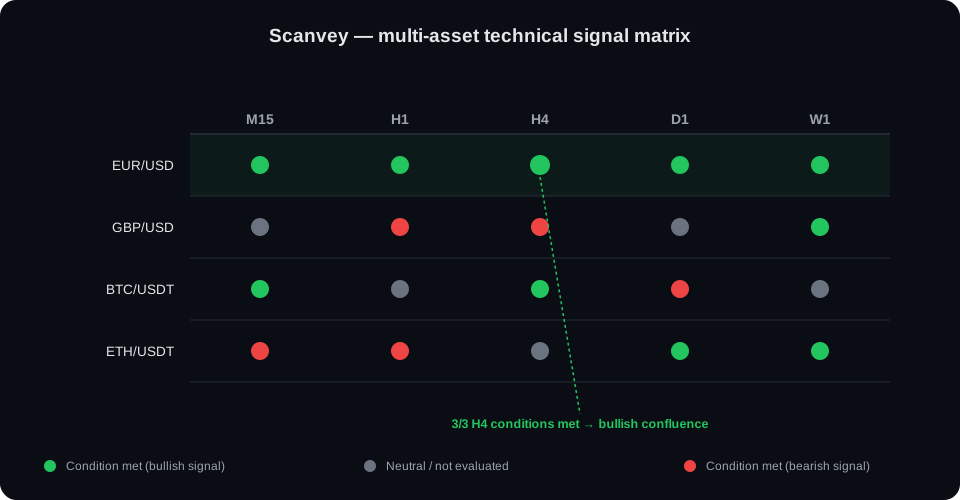
Monitoring MA crossover status across multiple forex pairs — whether the MA50 is above or below the MA200, whether a recent crossover has occurred — is one of the most common scanning tasks traders run daily. Scanvey automates this: it displays the MA crossover status for MA10, MA50, and MA200 across all pairs and all timeframes simultaneously in a single matrix, so regime changes are visible at a glance rather than requiring chart-by-chart inspection.
MA Crossovers in Multi-Timeframe Context
As with all technical indicators, MA crossovers produce their strongest signals when they align across multiple timeframes.
The top-down hierarchy:
D1 50/200 golden cross (bullish regime established): The primary filter. Only take long setups in pairs with a golden cross on D1.
H4 20/50 bullish crossover (continuation signal during correction): Within the D1 bullish regime, a 20/50 bearish crossover on H4 confirms the correction is in progress. When the 20/50 bullish crossover forms on H4 (faster MA crossing back above slower MA), the correction is likely ending and the primary trend is resuming. This is the entry preparation signal.
H1 10/50 bullish crossover (entry trigger): The H1 10/50 crossover provides the precise entry timing — the most recent, fastest confirmation that momentum has shifted in the direction of the primary trend.
A trade aligned across all three of these crossover signals (D1 regime bullish, H4 corrective crossover completing, H1 trigger crossover forming) has multi-timeframe momentum confluence from three independent timeframe layers. This is significantly more reliable than any single crossover signal in isolation.
Combining MA Crossovers with Other Indicators
MA crossovers alone do not provide complete analytical information. They indicate direction of momentum — they do not indicate whether price is at a significant level, whether momentum is sustainable, or whether the market environment favours trend-following.
MA crossover + RSI: RSI above 50 at the same time as a bullish MA crossover confirms that momentum is genuinely recovering rather than producing a temporary noise-driven crossover. A bullish MA crossover on H4 with RSI still below 40 is a premature signal — the momentum evidence is incomplete. RSI recovering above 50 alongside the crossover provides stronger confirmation.
MA crossover + Key level: A bullish MA crossover occurring while price is at or bouncing from a significant support level combines a momentum signal with a structural signal. The level provides the "why here" context — price is not just crossing a mathematical line, it is crossing it while bouncing from a zone where buyers have historically overwhelmed sellers.
MA crossover + MACD: The MACD histogram turning from negative to positive at approximately the same time as a bullish MA crossover provides dual momentum confirmation from two independent calculations. Both signals are based on moving averages, so they are correlated — but they are calculated differently enough that simultaneous confirmation adds meaningful weight.
MA crossover + Volume (where available): In markets with reliable volume data, a MA crossover accompanied by a volume spike confirms that the directional move is backed by genuine participation. In forex, tick volume serves as a proxy — a crossover on a high tick-volume candle is more significant than one on a thin-volume candle.
Stop Placement with MA Crossover Strategies
One advantage of MA-based entries is that the MAs themselves provide natural stop reference points.
For a long entry at an H4 20/50 bullish crossover:
- The stop goes below the slower MA (MA50) — if price closes back below the MA50, the crossover has failed and the trade premise is invalidated.
- Buffer: 10–20 pips below the MA50 to avoid being stopped by normal spread fluctuations.
For a long entry at a three-MA aligned setup (MA10 above MA50 above MA200 on H4):
- The stop goes below the MA50. A close below the MA50 means the short-term and medium-term MAs are no longer both above the long-term MA — the alignment has broken.
This structural stop placement has a key advantage: it is grounded in the same analytical logic as the entry. The MAs that signalled the entry are also the levels that invalidate it — creating internal consistency in the trade's logic.
Common MA Crossover Mistakes
Treating every crossover as a trade. Not every MA crossover produces a follow-through move. The filter — slower MA sloping in the direction of the trade, D1 trend aligned, RSI confirming — must be applied consistently. Entering every crossover without filtering is the fastest way to learn, at significant cost, why these filters exist.
Using the same combination on all timeframes. The 50/200 combination on D1 is a powerful regime signal. The same combination on M15 generates signals so frequently that it is unusable as a standalone approach. Match the MA period to the timeframe: longer periods for slower timeframes, shorter periods for faster ones.
Not accounting for the lag. Because crossovers are lagging signals, entering immediately on a crossover sometimes means entering after a large portion of the move has already occurred. Use the crossover as confirmation that the regime has changed, not as the precise entry point. Often the best entry is on the first pullback after the crossover, not the crossover itself.
Ignoring the slope of the MAs. Two MAs can be close together without clearly crossing — the signal is ambiguous. Two MAs crossing while both slope in the direction of the trade is a clean, high-quality signal. Two MAs crossing while the slower one is flat or moving in the opposite direction is a weaker signal requiring additional confirmation.
Conclusion
The moving average crossover is one of the most durable concepts in technical analysis because it captures something genuinely true about market behaviour: sustained directional momentum shifts are preceded and accompanied by shorter-term averages overcoming longer-term ones. That relationship is as valid today as it was when moving averages were first plotted by hand.
What has changed is the sophistication of the framework around the signal. Used in isolation, MA crossovers are a blunt tool with well-documented limitations. Used as part of a multi-timeframe, multi-indicator confluence framework — with regime filters, structural level context, and momentum confirmation from independent indicators — they are a reliable and time-tested component of a complete analytical approach.
The signal has been around for decades. The edge comes from knowing exactly when and how to apply it.
Related articles:
- Golden Cross and Death Cross in Forex
- MACD Forex Trading: Complete Strategy Guide
- Forex Confluence Trading: How Multiple Signals Work
- Daily Chart Forex Analysis
Frequently asked questions
Does the 50/200 moving average crossover actually work in forex?
Yes, with context. The MA50/MA200 crossover (golden cross / death cross) on the daily chart is one of the most reliable regime-change signals in forex. It does not work as a tactical entry signal — it is too lagging for that — but as a regime indicator it reliably identifies when the medium-term trend has shifted above or below the long-term baseline. Used to define the directional bias for the month or quarter rather than for precise entries, it performs consistently on the major pairs.
What is the best MA combination for forex crossover strategies?
For regime identification on D1: MA50 vs MA200 (golden cross/death cross). For medium-term momentum on H4: MA10 vs MA50. For shorter-term momentum confirmation: MA20 vs MA50. The combination of all three as an alignment system — MA10 above MA50 above MA200 on D1 — is one of the clearest trend confirmation signals available, and the basis of the three-MA alignment framework used by many systematic traders.
How do you filter false MA crossover signals?
Three main filters: (1) require the crossover to occur in the direction of the higher-timeframe trend — a golden cross on H4 is more reliable when the D1 is already in an uptrend, (2) require RSI above 50 at the time of the crossover confirming momentum alignment, (3) require the crossover to occur near a key structural level rather than in the middle of open space. False crossovers in ranging markets are significantly reduced when all three filters are applied.
Are MA crossovers better on D1 or H4 for forex?
D1 crossovers are more reliable as regime signals — they confirm macro trend changes and carry more statistical weight because each candle represents a full day of global trading activity. H4 crossovers are more useful for entry timing — they provide earlier signals within the context established by the D1, allowing more precise entries than waiting for a full D1 crossover. Most systematic traders use D1 for regime and H4 crossovers for entry triggers within that regime.
How much lag is acceptable before a crossover signal is too late?
Some lag is inherent to any moving average crossover — it is a trend-following signal by design. The practical threshold is whether the move still has room to run once the crossover confirms: on D1, a signal confirming within a few days of the actual trend shift is still tradeable, while one confirming weeks after the move has already extended is better treated as confirmation of trend rather than an entry trigger.
Further reading
These reference resources complement the analysis presented in this article:
Related reading
Track every indicator in one matrix
MA, RSI, MACD and Ichimoku calculated automatically across your entire watchlist.
Discover ScanveyThis article is for informational and educational purposes only. It does not constitute investment advice or a trading signal. Trading financial products involves a high risk of capital loss. Full risk disclaimer