MACD Forex Trading: Complete Strategy Guide
Complete guide to trading forex with the MACD indicator. Optimal settings, signal interpretation, and how to combine MACD with trend tools.
Published on 4 June 2026
Half the trades taken on a simple MACD crossover end in a stop-out — not because the indicator is flawed, but because most traders treat it as a standalone entry signal. That is not what it was built for.
Developed by Gerald Appel in the late 1970s, the Moving Average Convergence Divergence indicator was designed to measure the relationship between two exponential moving averages, turning that relationship into a readable momentum signal. The concept is elegant: when short-term price momentum is stronger than medium-term momentum, the MACD is positive. When medium-term momentum dominates, it is negative. The crossover between the two is the signal.
In practice, traders either apply MACD mechanically — entering on every signal line crossover regardless of context — or dismiss it as too lagging to be useful. Neither position is correct. Used with proper understanding and appropriate context, MACD is one of the most reliable momentum confirmation tools available for forex swing trading.
How MACD Works: The Mathematics Behind the Signal
Understanding why MACD signals behave the way they do requires understanding what it actually calculates.
The MACD line is the difference between two exponential moving averages of price — typically the 12-period EMA and the 26-period EMA:
MACD Line = EMA(12) − EMA(26)
When the 12-period EMA is above the 26-period EMA (short-term momentum is stronger than medium-term), the MACD line is positive. When the 26-period EMA is above the 12-period EMA (medium-term momentum is stronger), the MACD line is negative. The MACD line crossing zero is equivalent to the 12 and 26 EMA crossing each other.
The signal line is a 9-period EMA of the MACD line itself:
Signal Line = EMA(9) of the MACD Line
It smooths the MACD line, providing a slower reference against which the MACD line is compared. When the MACD line crosses above the signal line, momentum is accelerating bullishly. When it crosses below, momentum is decelerating or turning bearish.
The histogram is the visual representation of the relationship between the MACD line and the signal line:
Histogram = MACD Line − Signal Line
When the histogram is positive and growing, the MACD line is above the signal line and the gap between them is widening — momentum is building. When the histogram is positive but shrinking, momentum is fading. When the histogram crosses zero, the MACD line and signal line have crossed. The histogram makes the subtle changes in momentum visible at a glance.
The standard MACD settings (12, 26, 9) are the default on virtually every trading platform and are widely referenced by institutional and retail participants alike. There is a self-reinforcing element to this: because so many participants watch the same settings, signals at the standard parameters carry more market-observational weight than custom settings that fewer traders reference.
| MACD Parameters | Fast EMA | Slow EMA | Signal | Best For | Timeframe |
|---|---|---|---|---|---|
| Default (12/26/9) | 12 | 26 | 9 | Swing trading; most widely watched | D1, H4 |
| Scalping (5/13/6) | 5 | 13 | 6 | Fast momentum signals; more noise | H1, M15 |
| Swing (19/39/9) | 19 | 39 | 9 | Slower, higher-conviction signals | D1, W1 |
The Three MACD Signals
MACD generates three distinct types of signals, each with different applications and reliability profiles.
Signal 1 — The MACD/Signal Line Crossover
The most commonly discussed MACD signal: the MACD line crossing above or below the signal line.
Bullish crossover: MACD line crosses above the signal line. Short-term momentum is accelerating above the medium-term average — a signal that bullish momentum is building or resuming.
Bearish crossover: MACD line crosses below the signal line. Medium-term momentum is beginning to dominate — a signal that bearish momentum is building or resuming.
The reliability of crossover signals depends heavily on market context. In trending markets, crossovers in the direction of the trend are reliable continuation signals, particularly when they occur after the MACD line has pulled back toward the signal line during a correction. In ranging, choppy markets, crossovers occur frequently and produce a high rate of false signals — the MACD line oscillates back and forth across the signal line without producing directional momentum.
The practical filter: only act on crossover signals that are consistent with the D1 trend direction. A bullish MACD crossover on H4 in a confirmed D1 uptrend is a high-quality continuation signal. A bullish MACD crossover on H4 against a D1 downtrend is a lower-quality counter-trend signal.
Applying that D1-trend filter across a full watchlist means checking the D1 trend and the H4 MACD crossover separately for every pair. Scanvey displays MACD direction alongside trend indicators on both timeframes for all pairs at once, so the high-quality continuation setups described above stand out without the two-step manual check — see how to detect these crossovers across multiple pairs for the workflow behind that shortlist.
Signal 2 — The Zero Line Cross
The MACD line crossing above or below zero is equivalent to the underlying 12 and 26 EMAs crossing each other — a signal closely related to the golden cross / death cross concept.
MACD above zero: The 12-period EMA is above the 26-period EMA — the shorter-term trend is bullish relative to the medium-term trend. This is a bullish regime confirmation.
MACD below zero: The 26-period EMA is above the 12-period EMA — the shorter-term trend is bearish relative to the medium-term trend. Bearish regime.
The zero line cross is a slower, more significant signal than the MACD/signal line crossover. On D1, a MACD line that crosses above zero after an extended period below it signals a genuine momentum regime change — not just a temporary acceleration. This signal is valuable as a regime filter: trade long when MACD is above zero on D1, short when below.
The zero line cross is less useful as a timing tool because it lags significantly. By the time MACD crosses zero on D1, a substantial move has already occurred. Its value is in confirming that the regime has genuinely shifted, not in timing entry.
Signal 3 — Divergence
MACD divergence is arguably the most powerful and least appreciated signal in the system. It occurs when price and MACD move in opposite directions — a warning that the current price trend is losing momentum support.
Bearish divergence: Price makes a new higher high, but the MACD line (or histogram) makes a lower high at the same time. This means that even though price advanced to a new high, the momentum behind that advance was weaker than the previous high. The uptrend may be running out of fuel.
Bullish divergence: Price makes a new lower low, but MACD makes a higher low. The downtrend is continuing to new lows, but with decreasing momentum — a warning that the downtrend may be approaching exhaustion.
Divergence is most reliable on D1 and H4 timeframes, at significant structural levels, after extended trends. A bearish divergence forming on D1 at a major resistance level, after a multi-month uptrend, with RSI also showing divergence, is a high-confidence reversal warning. A divergence signal on M15 at a minor intraday level is noise.
The critical discipline with divergence: it is a warning signal, not an entry trigger. Divergence can persist for multiple candles before price finally turns. Do not enter on divergence alone — wait for a confirming entry candle (pin bar, engulfing, or MA crossover) before acting.
MACD Settings for Forex
The standard (12, 26, 9) settings work well for D1 and H4 forex analysis. However, understanding how changing the settings affects the signal behaviour allows you to adapt the indicator to specific needs.
Faster settings (e.g., 5, 13, 6 or 8, 17, 9): These produce more signals with shorter lookback periods. Useful for H1 trading where the standard settings may be too slow to capture intraday momentum shifts. The trade-off: more signals means more false signals. Faster MACD settings require stricter contextual filters.
Slower settings (e.g., 21, 55, 9): These reduce signal frequency and focus on longer-term momentum shifts. Useful for weekly chart analysis or for traders who want a macro momentum filter with minimal noise. The trade-off: signals lag significantly — useful for regime identification, not for timing entries.
For most swing traders using D1 and H4, the standard (12, 26, 9) settings are the right starting point. Deviating from them without a specific reason introduces inconsistency without clear benefit.
MACD in Multi-Timeframe Analysis
MACD performs best when applied within a multi-timeframe framework rather than in isolation. See multi-timeframe MACD analysis for the full three-level method.
D1 MACD — regime and directional bias: Check MACD on D1 first. Is the MACD line above zero (bullish regime) or below zero (bearish)? Is the histogram positive and expanding (trend strengthening), positive and contracting (trend potentially topping), or negative and expanding (downtrend strengthening)? This D1 reading defines the context for all lower-timeframe signals.
H4 MACD — entry timing: Within the D1 regime established above, watch for H4 MACD signals that align with the D1 direction. A bullish MACD crossover on H4 (MACD line crossing above signal line) during a pullback in a D1 uptrend is the primary entry signal in a MACD-based swing trading approach. The pullback caused the H4 MACD to turn negative; the crossover back above the signal line signals the pullback is ending and the trend is resuming.
The histogram convergence pattern: One of the most reliable MACD signals on H4 is a histogram that declines from a positive peak toward zero (pullback in progress), then begins to expand positively again (pullback ending, trend resuming) — all while the D1 histogram remains positive. This pattern — often called a "hook" — captures the transition from correction to continuation with good precision.
Combining MACD with Other Indicators
MACD is most effective as part of a confluence framework rather than as a standalone signal.
MACD + RSI: These two indicators complement each other naturally. RSI measures the speed and magnitude of price changes; MACD measures momentum direction and convergence between moving averages. They can diverge from each other in ways that reveal nuance: an RSI that is recovering above 50 while MACD histogram is just turning from negative to zero suggests early momentum recovery — not yet confirmed, but approaching. Both turning positive simultaneously is the stronger signal.
MACD + Moving Averages: MACD crossover signals become significantly more reliable when the price is on the correct side of the MA200. A bullish MACD crossover while price is above D1 MA200 is a trend-following signal. The same crossover while price is below MA200 is a potential counter-trend signal — lower probability, requiring more caution.
MACD + Key Levels: A MACD bullish crossover occurring while price is testing a significant support level combines momentum recovery with structural significance. The level provides the "why here" context that MACD alone cannot supply.
MACD + Ichimoku: Using Ichimoku for regime and level identification, with MACD as the momentum confirmation, creates a complete analytical combination. The Ichimoku cloud defines whether the trade direction is with or against the dominant regime; MACD confirms that momentum is moving in the trade direction; the TK cross and MACD crossover occurring together produces a high-confidence entry signal.
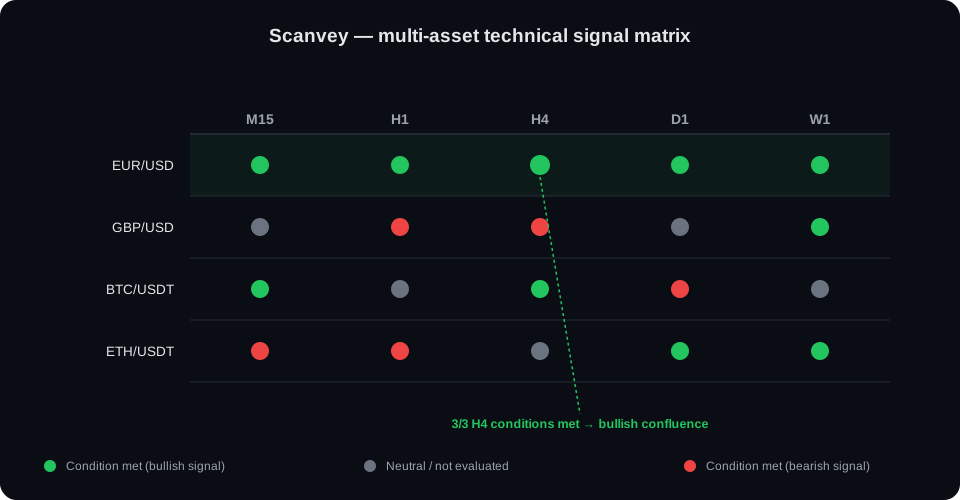
Scanvey displays MACD conditions — including histogram direction and MACD/signal line crossover status — alongside RSI, MA crossovers, and Ichimoku for all pairs across all timeframes in a single matrix. Rather than checking MACD on D1, switching to H4 to check MACD again, then repeating for each pair, the matrix shows which pairs have multi-timeframe MACD alignment at a glance, focusing manual analysis where the confluence actually exists.
The Most Reliable MACD Setups in Forex
Based on the signal types above, these are the highest-probability MACD setups for forex swing trading:
The pullback resumption (H4, with D1 confirmation): D1 MACD is above zero and histogram is positive. Price pulls back on H4, causing H4 MACD histogram to turn negative. As price approaches a key H4 support level, H4 MACD histogram begins recovering (less negative, approaching zero). When the H4 MACD line crosses above the signal line at or near the key level, enter long. Stop below the key level. Target: next structural resistance.
The zero line recross after correction (D1): D1 MACD has been above zero for an extended trend. A correction pushes the MACD line briefly below zero (or close to it). When the MACD line crosses back above zero with an expanding histogram, the correction is likely over and the primary trend is resuming. This signal produces excellent reward-to-risk setups because the stop can be placed at the recent correction low while the target is the continuation of the prior trend.
The divergence reversal (D1, at major level): After an extended D1 uptrend, bearish MACD divergence forms at a major resistance level (price makes new high, MACD histogram makes lower high). Wait for a confirming D1 reversal candle before entering short. This is a higher-risk setup (trading against the trend) but produces excellent reward when the divergence is clear and the structural level is significant.
Common MACD Mistakes in Forex
Acting on every crossover. The MACD signal line crossover is not a buy or sell signal in isolation — it is a momentum shift indicator that requires context. In a ranging market, the crossover fires repeatedly with no follow-through. Apply the D1 regime filter first — see how to filter false MACD crossovers for the full method. For the tool concept behind scanning crossovers across a watchlist, see MACD crossover scanner explained.
Using MACD as a standalone entry system. MACD tells you about momentum. It does not tell you where you are in the price structure, whether you are approaching a key level, or whether the broader trend supports the trade. It is one input in a multi-signal decision, not the complete decision.
Chasing crossovers after large moves. When a MACD crossover occurs after a large directional candle, entering on the next open often means entering at an extended price level. The best MACD crossover entries occur during corrective phases — when the histogram has been declining toward zero and then turns — not after a spike.
Ignoring divergence until it is obvious. By the time divergence is crystal clear and widely commented on, the setup is often mature or already reversing. Learn to spot divergence early — two data points (one high/low and a second, contradicting high/low) is enough to identify a developing divergence pattern and begin watching for confirmation.
Conclusion
MACD's longevity as a technical indicator — over four decades of widespread use across every market — reflects a genuine analytical insight: momentum often precedes or contradicts price in ways that reveal the underlying strength or weakness of a move.
Applied with context — D1 regime awareness, multi-timeframe alignment, structural level conjunction, and confluence with complementary indicators — MACD is a reliable, time-tested tool for forex momentum analysis. Applied without context — as a mechanical crossover signal on any timeframe in any market condition — it is a recipe for inconsistent results.
The indicator has not changed since Appel developed it in the 1970s. What changes is the quality of the framework that surrounds it.
Related articles:
- RSI Forex Settings Guide
- Technical Indicators Combination Guide
- Golden Cross and Death Cross in Forex
- Forex Confluence Trading: How Multiple Signals Work
Frequently asked questions
What are the best MACD settings for forex trading?
The standard settings (12, 26, 9) remain the most widely used and effective for swing trading on D1 and H4. These settings were designed by Gerald Appel for intermediate-term trend analysis and have remained the default across platforms for decades. Shortening the periods (e.g. 5, 13, 6) makes MACD more responsive for shorter-term trading but increases false signals significantly. For forex swing trading, the standard settings on D1 and H4 are the best starting point.
Is MACD reliable for swing trading forex?
MACD is a strong momentum confirmation tool for forex swing trading when used with proper context. The most reliable MACD setups occur when the signal line crossover aligns with the D1 trend direction, occurs at or near a key structural level, and is confirmed by RSI above or below 50. Used mechanically on every crossover without trend context, MACD's signal quality drops sharply — particularly in ranging markets where crossovers occur repeatedly in both directions.
How do you use MACD divergence in forex?
MACD divergence occurs when price makes a new high (or low) but the MACD histogram does not confirm the move — it makes a lower high (or higher low). This divergence signals weakening momentum and often precedes a reversal or deep correction. Regular bearish divergence (price higher, MACD lower) on D1 at a key resistance level, combined with RSI overbought, is one of the most reliable reversal signals in technical analysis.
Should MACD be used as a standalone indicator?
No — MACD is a momentum confirmation and divergence tool, not a complete trading system. On its own, MACD crossovers produce a high percentage of false signals, particularly in ranging markets. MACD is most effective as the third element of a confluence framework: trend direction established by moving averages, structural level identified on the chart, then MACD confirming momentum alignment. In that context, it adds genuine value.
What is the difference between the MACD line and the MACD histogram?
The MACD line is the difference between two exponential moving averages. The histogram measures the distance between the MACD line and its signal line — a moving average of the MACD line itself. The histogram is more sensitive and turns before the line crosses the signal, which is why many traders watch histogram direction for early momentum shifts rather than waiting for the slower line crossover.
Further reading
These reference resources complement the analysis presented in this article:
Related reading
Track every indicator in one matrix
MA, RSI, MACD and Ichimoku calculated automatically across your entire watchlist.
Discover ScanveyThis article is for informational and educational purposes only. It does not constitute investment advice or a trading signal. Trading financial products involves a high risk of capital loss. Full risk disclaimer