RSI in Forex: Best Settings and Strategy Guide
The best RSI settings for forex trading across timeframes. How to read RSI correctly, avoid false signals, and spot high-probability reversals.
Published on 4 June 2026
Selling at RSI 70 and buying at RSI 30 is the most common reading of the indicator — and one of the most expensive in a strong trend, exactly the regime where forex and crypto markets spend most of their time.
That standard interpretation — overbought above 70, oversold below 30 — is technically accurate but practically incomplete. Applied mechanically in trending markets, it consistently leads traders to sell into strong uptrends and buy into strong downtrends. A pair can remain "overbought" for weeks while advancing hundreds of pips.
The RSI is not an overbought/oversold signal generator. It is a momentum measurement tool that reveals whether price is in a bullish or bearish momentum regime, whether that momentum is strengthening or weakening, and when it is diverging from price in ways that signal potential reversals. Understood properly, it is one of the most versatile indicators in a forex trader's toolkit.
What RSI Actually Measures
Developed by J. Welles Wilder and published in 1978 in New Concepts in Technical Trading Systems, the Relative Strength Index measures the speed and magnitude of recent price changes on a normalised 0–100 scale.
The calculation:
RSI = 100 − (100 / (1 + RS))
Where RS = Average gain over N periods / Average loss over N periods.
In plain terms: RSI compares how much price has risen on up days versus how much it has fallen on down days over the lookback period. If price has closed higher on most of the recent N periods with relatively large moves, RSI will be high. If price has closed lower on most recent periods, RSI will be low.
The result is a bounded oscillator between 0 and 100. The midpoint — 50 — is where average gains and average losses are equal. Above 50 means net bullish momentum dominates the lookback period. Below 50 means net bearish momentum dominates.
This midpoint is far more important for forex trading than the 70 and 30 extremes.
The Right Way to Read RSI: The 50 Line
In trending forex markets, the most important RSI reference is not 70 (overbought) or 30 (oversold) — it is 50 (the momentum midline).
RSI above 50 = bullish momentum regime. The average gain over the lookback period exceeds the average loss. Bulls are winning more than they are losing. This is the regime in which long setups have directional momentum at their back.
RSI below 50 = bearish momentum regime. The average loss exceeds the average gain. Bears are winning. Short setups have directional momentum at their back.
RSI crossing above 50 from below signals a potential momentum regime change from bearish to bullish — a more significant event in trending markets than a signal line crossover from an arbitrary level.
RSI crossing below 50 from above signals a momentum regime change from bullish to bearish.
In practice, using RSI above/below 50 as a directional filter immediately improves the quality of other entry signals. A moving average crossover that occurs while RSI is above 50 on the same timeframe has stronger momentum backing than one where RSI is still below 50. A bullish candle pattern at a key support level carries more weight when RSI is recovering above 50 than when it is still declining below it.
The 50-line filter is the single most underused RSI application in retail forex trading.
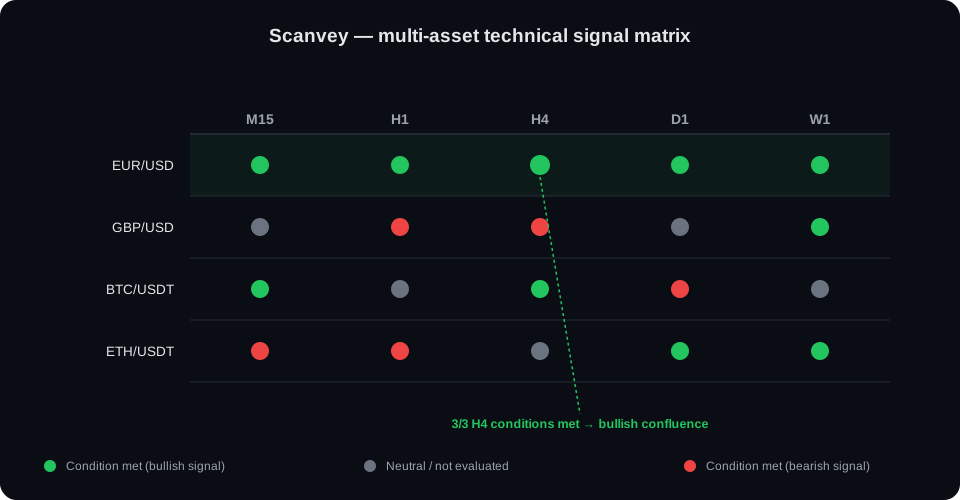
Underused partly because checking it consistently across a full watchlist means opening every pair to read one number. Scanvey displays each pair's RSI status relative to 50, across every timeframe, in a single matrix — turning the 50-line filter described above into something you can apply to 30 pairs as easily as one. See RSI scanner explained for the underlying concept, or how to filter forex pairs using RSI for the step-by-step method.
RSI Settings for Forex
The standard RSI period is 14, and for most forex applications on D1 and H4, it is the right starting point. But understanding how period length affects behaviour allows you to choose settings deliberately.
| Trading Style | RSI Period | Overbought Level | Oversold Level | Best Timeframe |
|---|---|---|---|---|
| Scalping | 7–9 | 70 | 30 | M5, M15 |
| Day Trading | 10–14 | 70 | 30 | M15, H1 |
| Swing Trading | 14 | 70 | 30 | H4, D1 |
| Position Trading | 14–21 | 65 | 35 | D1, W1 |
RSI(14) — The Standard
The 14-period RSI is the most widely used setting across all timeframes and asset classes. Wilder chose 14 periods as a reasonable balance between sensitivity (fast enough to react to meaningful momentum shifts) and smoothness (slow enough to filter minor noise).
On D1, RSI(14) reflects approximately three calendar weeks of trading data. On H4, it reflects approximately 56 hours. These are meaningful lookback windows for swing trading: long enough to reflect genuine momentum trends, short enough to detect shifts within those trends.
RSI(14) is the setting to use unless you have a specific reason to deviate.
RSI(9) — Faster, More Sensitive
A 9-period RSI responds more quickly to price changes. It will cross above and below 50 more frequently and will reach overbought/oversold levels more readily. Useful for H1 or M30 analysis where faster signals are needed, but generates more false signals on D1 and H4.
Some traders use RSI(9) on H4 to get earlier warning of momentum shifts before the RSI(14) confirms them. If RSI(9) crosses above 50 while RSI(14) is still below 50, the 9-period signal is an early indication of momentum recovery — not yet confirmed, but worth noting.
RSI(21) — Slower, More Reliable
A 21-period RSI is slower and will stay in ranges longer before crossing the 50 line. On D1, RSI(21) reflects approximately one calendar month of price data — useful as a longer-term momentum regime filter. On D1, RSI(21) above 50 is a meaningful monthly momentum confirmation; crossings of 70 and 30 with RSI(21) on D1 represent sustained overbought/oversold conditions rather than temporary spikes.
Useful application: use RSI(14) for entry timing and RSI(21) for regime confirmation on the same chart. When both are above 50, the bullish momentum regime is confirmed on multiple measurement horizons. When they diverge (14 above 50 but 21 below), the signal is more ambiguous.
The Overbought/Oversold Framework: When It Actually Works
Having established that RSI 70/30 should not be used mechanically in trending markets, it is worth explaining when the overbought/oversold framework genuinely works.
In ranging markets. When a pair is oscillating between a defined support and resistance zone without establishing a directional trend, RSI tends to oscillate between roughly 35 and 65 — rarely reaching the extremes, but reverting from them reliably when it does. In this environment, RSI above 65 at the top of the range and below 35 at the bottom of the range provides genuine entry signals. The key: confirm you are in a ranging market before applying this framework.
At major structural levels after extended trends. An RSI reading above 75 or 80 after a multi-week advance, at a significant resistance level, provides meaningful evidence of momentum exhaustion. The combination of extreme RSI, major resistance, and a reversal candle pattern is a high-quality setup. RSI alone at 75 is not enough — the structural context must accompany it.
With divergence (covered in detail below). RSI reaching overbought territory while the subsequent price high shows RSI at a lower high is a classic bearish divergence signal — the type of setup where the overbought reading contributes genuine analytical value, not as a standalone signal but as one component of a divergence pattern.
The consistent theme: RSI extreme readings (above 70 or below 30) are meaningful when combined with structural context. Isolated RSI extremes in trending markets are not reversal signals — they are momentum confirmations.
RSI Divergence: The Highest-Value Signal
RSI divergence is the most powerful signal the indicator produces, and it is the one that most justifies the time investment in learning to read RSI properly.
Bearish divergence occurs when price makes a new higher high but RSI makes a lower high at the same time. This means the second price high was achieved with less momentum than the first — upside energy is declining even as price advances. The trend may continue briefly, but the internal momentum structure is weakening.
Bullish divergence occurs when price makes a new lower low but RSI makes a higher low. The downtrend continues to new lows, but with decreasing momentum — a warning that selling pressure is fading even as price declines.
Hidden divergence is a continuation signal. Hidden bullish divergence: price makes a higher low during a pullback (consistent with an uptrend), while RSI makes a lower low — suggesting that although RSI pulled back further, price structure remains bullish. This is a trend continuation signal. Hidden bearish divergence: price makes a lower high during a bounce (consistent with a downtrend), while RSI makes a higher high — continuation of the downtrend likely.
Practical application rules for RSI divergence:
First, divergence must be identified on the correct timeframe for it to be actionable. Divergence on D1 after an extended multi-week trend signals a potential medium-term reversal. Divergence on M15 during an intraday move is noise.
Second, divergence is a warning signal, not an entry trigger. Do not enter against the trend simply because divergence has appeared. Wait for a confirming entry candle — a pin bar, engulfing pattern, or MA crossover — before acting.
Third, the stronger and more extended the trend, the more significant the divergence. A bearish divergence forming after a three-month rally at a major resistance level is far more significant than divergence forming after a three-day rally in a choppy range.
RSI Across Multiple Timeframes
RSI produces its most reliable signals when aligned across multiple timeframes — a directional confirmation that spans from the longer-term context down to the entry level. See multi-timeframe RSI analysis for the full three-level method.
D1 RSI as regime filter: The D1 RSI reading establishes the momentum regime for the trading session. D1 RSI above 50 = only take long setups on lower timeframes. D1 RSI below 50 = only take short setups. D1 RSI near 50 with no clear direction = reduce trading activity until the regime clarifies.
H4 RSI as entry timing: Within the D1 regime, H4 RSI provides the entry timing signal. In a D1 bullish regime, watch for H4 RSI to decline toward 40–50 during a correction (confirming the pullback) then recover above 50 (confirming the pullback is ending). The recovery above 50 on H4 RSI, combined with a bullish H4 candle pattern at a key level, is the entry signal.
H1 RSI as precision timing: For traders who want precise entry points within a confirmed H4 setup, H1 RSI crossing above 50 provides the final timing confirmation. At this point — D1 bullish, H4 RSI recovering above 50, H1 RSI crossing above 50 — the full multi-timeframe momentum stack is aligned.
This stacked RSI confirmation approach reduces false signals dramatically. Each timeframe layer must be in alignment for the trade to be taken at full size.
RSI Combined with Other Indicators
RSI performs best as one indicator within a multi-indicator confluence framework.
RSI + Moving Averages: RSI above 50 combined with price above the D1 MA50 and MA200 creates a double momentum and trend confirmation. Both signals are independent (RSI is a price change ratio; MAs are price level averages) and their agreement strengthens the case considerably.
RSI + MACD: RSI and MACD both measure momentum but through different calculations. RSI compares gains to losses; MACD compares two EMAs. When both cross above their respective midpoints simultaneously (RSI above 50 and MACD histogram turning positive), the dual-indicator momentum confirmation is more reliable than either alone.
RSI + Ichimoku: Ichimoku provides the structural and regime context (price above/below cloud, TK cross direction); RSI confirms the momentum quality within that structure. A bullish TK cross on Ichimoku combined with RSI recovering above 50 from a correction low is a complete signal that combines structural, directional, and momentum confirmation.
RSI + Support/Resistance levels: RSI recovery from near the 40 level while price is testing a key support zone provides evidence that buyers are stepping in at the level. It is not proof — price can break support despite RSI recovering — but it increases the probability that the level will hold.
Scanvey tracks RSI conditions — including above/below 50 status — for all pairs across all timeframes simultaneously. Seeing which pairs have RSI above 50 on both D1 and H4 (full momentum alignment) versus which have D1 RSI bullish but H4 RSI still recovering (correction in progress) takes seconds in a matrix view rather than the minutes required to check each chart manually.
The Most Common RSI Mistakes in Forex
Shorting because RSI is above 70 in an uptrend. This is the most costly RSI misapplication. In strong uptrends, RSI stays above 70 for extended periods. Selling every time RSI exceeds 70 in a bull market is systematically fighting the trend. Reserve overbought readings for reversal signals only when structural and divergence context accompanies them. See how to filter false RSI signals for a full filtering method.
Acting on RSI in isolation. RSI above 50 is a momentum condition, not a trade. It tells you the directional bias but nothing about where price is in its structure, whether a key level is nearby, or whether other indicators confirm. RSI needs context.
Using the same RSI application across all timeframes. RSI(14) on D1 as a regime filter, RSI(14) on M15 as an entry trigger, and RSI(14) on W1 as a macro filter are three different analytical tools despite sharing the same indicator name. Treat them separately: each timeframe's RSI reading answers a different question.
Ignoring hidden divergence. Regular divergence (reversal signals) gets most of the attention, but hidden divergence (continuation signals) is arguably more useful in a trend-following framework. Hidden bullish divergence during a pullback in an uptrend is one of the highest-quality continuation entry signals RSI produces. Most traders never learn to look for it.
Conclusion
The RSI is a deeper and more versatile tool than its standard overbought/oversold reputation suggests. The 50-line framework for regime identification, divergence analysis for reversal and continuation signals, and multi-timeframe stacking for entry timing together provide a complete momentum analysis framework that works across all major forex pairs and timeframes.
The traders who get the most from RSI are not the ones who use the most sophisticated settings or the most complex interpretations. They are the ones who understand what the indicator actually measures — the ratio of recent gains to recent losses — and apply that understanding consistently within a well-defined analytical framework.
RSI does not predict the future. It measures the present with precision. That precision, in context, is enough.
Related articles:
- MACD Forex Trading: Complete Strategy Guide
- Technical Indicators Combination Guide
- Forex Confluence Trading: How Multiple Signals Work
- Moving Average Crossover: Complete Forex Guide
- RSI Divergence Scanner: Spot Divergences Across Your Entire Watchlist — spot these divergences across 60 assets without comparing every chart by hand
Frequently asked questions
What is the best RSI period setting for forex?
The standard 14-period RSI is the best default for most forex traders, particularly on D1 and H4. It was specifically calibrated by Wilder for daily charts and balances responsiveness with noise reduction effectively. Shorter periods (7–10) produce more signals but also more false ones; longer periods (21–28) smooth out the noise further but produce very few actionable signals. Most systematic traders use 14 on D1 and H4, occasionally shortening to 9–10 on lower timeframes.
How do I avoid false overbought and oversold signals in forex?
Stop treating RSI 70/30 as standalone buy/sell signals and start using the 50 line as your primary reference. Above 50 means bullish momentum regime; below 50 means bearish momentum regime. Use 70/30 crossings only as potential exhaustion warnings in the context of a trade already in progress, not as entry triggers. An RSI reading above 70 in a strong uptrend is confirmation of the trend, not a sell signal — the vast majority of traders who sell into strong uptrends at RSI 70 are leaving significant gains behind.
What is RSI divergence and how do I use it in forex?
RSI divergence occurs when price and RSI move in opposite directions — price makes a new high while RSI makes a lower high (bearish divergence), or price makes a new low while RSI makes a higher low (bullish divergence). This signals weakening momentum in the direction of the price move and is one of the most reliable reversal signals RSI produces. The highest-quality divergences occur on D1 at major structural levels, confirmed by a shift in H4 momentum direction.
Should RSI be used alone or combined with other indicators?
RSI is most valuable as part of a multi-indicator framework rather than in isolation. Its primary roles are regime identification (above/below 50), momentum confirmation (aligning RSI direction with trade direction), and divergence detection (momentum/price split). Combined with moving averages for trend context and MACD for timing confirmation, RSI adds genuine edge. Used alone as an entry signal, its false signal rate is too high for consistent profitability.
Does a shorter RSI period always mean more signals?
Generally yes, but not proportionally more useful ones. Shortening the period from 14 to 7 roughly doubles signal frequency but also roughly doubles the false-signal rate in choppy conditions, since the calculation reacts to less price history. The gain in responsiveness needs to be weighed against the corresponding loss in reliability for the specific timeframe being traded.
Further reading
These reference resources complement the analysis presented in this article:
Related reading
Track every indicator in one matrix
MA, RSI, MACD and Ichimoku calculated automatically across your entire watchlist.
Discover ScanveyThis article is for informational and educational purposes only. It does not constitute investment advice or a trading signal. Trading financial products involves a high risk of capital loss. Full risk disclaimer