Crypto Multi-Timeframe Analysis: BTC, ETH and Altcoins
Apply multi-timeframe analysis to crypto markets. Scan BTC, ETH and major altcoins across M15 to W1 for high-probability setups.
Published on 4 June 2026
Multi-timeframe analysis was developed in traditional financial markets — equities, futures, forex. But its core logic applies equally to crypto, and in some respects works even better: crypto markets are driven by retail sentiment and momentum more than any other asset class, and momentum is precisely what multi-timeframe analysis is built to detect.
The adaptation, however, is not trivial. Crypto markets have structural differences that change how you apply the methodology. No closing bell. No weekly gap. Extreme volatility. Correlation dynamics dominated by Bitcoin. These characteristics require specific adjustments to get the most out of multi-timeframe analysis on BTC, ETH, and altcoins.
This guide covers the full methodology — from timeframe hierarchy to indicator settings to practical scanning — with all the crypto-specific adaptations you need. For the timeframe question specifically, see best timeframes for crypto scanning.
Why Multi-Timeframe Analysis Works Especially Well in Crypto
Crypto markets are predominantly driven by retail participants. Unlike forex or equities, where institutional order flow creates structured, sometimes opaque price action, crypto prices reflect collective retail psychology with unusual clarity.
This has a concrete consequence: trend-following signals work exceptionally well during crypto bull phases, because retail momentum is self-reinforcing. When BTC is above its D1 MA200, moving averages on H4 and H1 all trend upward, and RSI stays elevated — and the multi-timeframe alignment holds for weeks or months, not just days.
Conversely, during bear phases, the alignment flips just as clearly. Price falls below the MA200. Higher timeframe MAs compress and eventually cross bearish. RSI stays below 50 persistently. The multi-timeframe alignment signals the regime change.
This regime clarity — bull or bear, trending or consolidating — makes crypto particularly well-suited to the top-down, multi-timeframe approach.
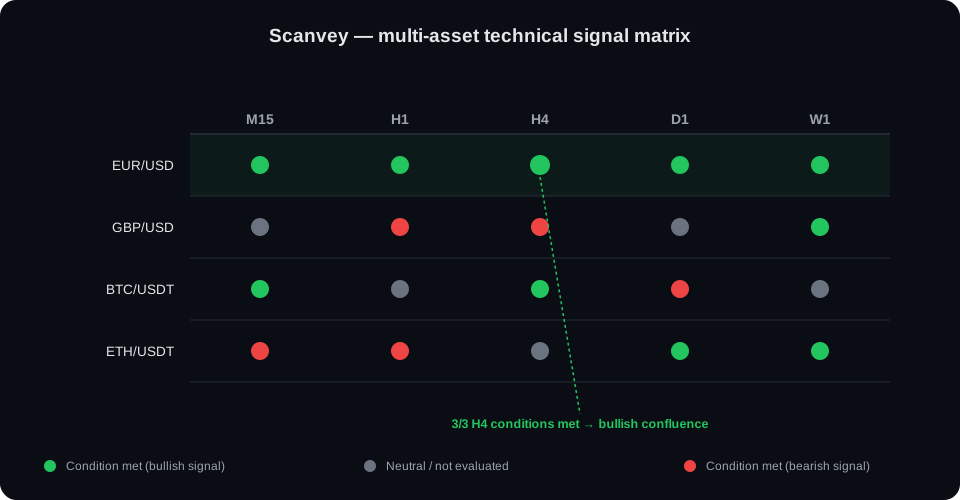
Applying multi-timeframe analysis across BTC, ETH, and altcoins simultaneously is where the process becomes slow if done manually — opening each asset on W1, D1, H4, H1, and M15 in sequence takes significant time. Scanvey compresses this by displaying the full multi-timeframe condition matrix for your entire crypto watchlist at once: MA alignment, RSI regime, MACD direction, all visible across all timeframes in a single view.
The Crypto Timeframe Hierarchy
The same five timeframes used in forex apply to crypto, with adjusted roles:
| Timeframe | Role in Crypto | Key Signals |
|---|---|---|
| W1 (Weekly) | Market cycle phase | Bull/bear regime, MA200 position |
| D1 (Daily) | Primary trend direction | MA alignment, RSI regime, MACD direction |
| H4 (4-Hour) | Intermediate swing structure | Entry zones, momentum confirmation |
| H1 (1-Hour) | Entry timing | Setup confirmation, zone reaction |
| M15 (15-Minute) | Execution precision | Trigger signals, entry and stop placement |
W1 — Reading the Market Cycle
In crypto, the weekly chart is the most important context timeframe. Crypto markets move in broad cycles — historically tied to Bitcoin halving events — and understanding which phase of the cycle you are in fundamentally changes the setups you should be taking.
Bull cycle characteristics on W1:
- Price consistently above the W1 MA200
- Weekly candles closing near their highs
- RSI sustaining above 50, frequently reaching 70+
- Each pullback to the W1 MA10 or MA20 is bought aggressively
Bear cycle characteristics on W1:
- Price below the W1 MA200
- Weekly candles closing near their lows
- RSI sustaining below 50, frequently reaching 30
- Each bounce toward the W1 MA20 or MA50 is sold
The W1 regime defines everything. During a confirmed bear cycle, even perfect D1 and H4 long setups have low success rates. During a bull cycle, the opposite is true — pullback entries work repeatedly because the underlying demand is strong.
D1 — The Primary Trend Anchor
The daily chart is the operational core of crypto MTA. It is where most swing trade setups form and where indicator signals are most reliable.
Key daily signals for crypto:
- MA10 above MA200 = bullish regime. The opposite = bearish regime.
- RSI above 50 = bulls in control. Below 50 = bears in control.
- MACD line above signal line = bullish momentum. The opposite = bearish.
- Price above the Ichimoku cloud = bullish structure. Below = bearish.
In a healthy bull market, BTC will spend weeks with all four of these conditions simultaneously bullish. That is the environment where buying every H4 pullback makes statistical sense.
H4 and H1 — Structure and Entry
These two timeframes serve the same role as in forex: H4 identifies intermediate structure and entry zones, H1 confirms the setup and provides entry timing.
The key difference in crypto: H4 and H1 candles can be significantly more volatile than their forex equivalents. A 3% move in a single H4 candle is not unusual for Bitcoin, and even more extreme for smaller altcoins. Entry zones should be wider, stops should account for this volatility, and position sizes should be adjusted accordingly.
Bitcoin as the Macro Filter
The most important adaptation for crypto MTA is treating Bitcoin as the dominant macro filter — equivalent to how a forex trader uses the weekly chart as their starting point.
Before analyzing any altcoin, check the Bitcoin technical analysis guide framework on BTC/USDT D1 and H4:
- Is BTC above its D1 MA200? If yes, the macro regime is bullish. Long setups on altcoins have higher probability.
- Is the BTC D1 MACD bullish? If yes, current momentum supports longs.
- Is BTC in a confirmed downtrend on D1? If yes, be extremely selective about any altcoin long — most will follow Bitcoin down regardless of their individual chart structure.
This Bitcoin-first approach prevents the most common crypto MTA mistake: taking a technically perfect long setup on ETH or SOL while Bitcoin is in a confirmed downtrend, then watching the altcoin sell off with BTC regardless of the signal quality.
Rule: If you would not be comfortable going long BTC at the current D1 structure, treat altcoin longs with significant caution regardless of what their individual charts show.
Indicators for Crypto MTA
Moving Averages — Adapted for Crypto Volatility
The same MA periods used in forex work well in crypto, with slight adaptations:
- MA10 / MA20 — Short-term momentum on H4 and below. Crossovers are reliable entry signals when aligned with higher timeframes.
- MA50 — Medium-term trend on D1. Key dynamic support/resistance during trending phases.
- MA200 — The most important level in crypto. Price above MA200 on D1 = bullish regime. Below = bearish regime. This single condition explains more of crypto price behaviour than any other indicator.
During extreme bull phases, the MA200 may be far below price and not useful for short-term entries. In this case, use the MA10/MA50 crossover on D1 as the primary trend filter instead.
RSI — The Regime Indicator
In crypto, RSI settings for crypto behave differently from forex in one important way: during strong trends, RSI can stay in "overbought" (above 70) or "oversold" (below 30) territory for much longer than in forex.
Do not treat RSI above 70 as an automatic sell signal in a bull market. It is not overbought — it is in a strong trend. The RSI signal that matters is whether it is above or below 50:
- RSI consistently above 50 across D1 and H4 = bull trend intact
- RSI dropping and holding below 50 = trend shift warning
Use RSI extremes (below 35 for buys, above 65 for sells) only for timing entries within the trend, not for calling reversals.
MACD — Momentum Confirmation
MACD works well on crypto H4 and D1 for the same reason it works in forex: it shows the relationship between short and longer-term momentum. A MACD bullish crossover on D1, following a correction to the MA50, is one of the strongest re-entry signals during a crypto bull phase.
On M15 and H1, use the MACD histogram crossing zero as an entry trigger. A positive histogram turn when price is at an H4 support zone is a clean, quantifiable signal.
Ichimoku — The Complete Picture
The Ichimoku cloud is particularly useful for crypto analysis because the cloud provides projected support and resistance — it shows you where price is likely to encounter obstacles in the future, not just where it has been.
During bull phases:
- Price sustained above the cloud = powerful confirmation
- Tenkan-sen crossing above Kijun-sen = entry signal
- Bullish Kumo twist ahead = increasing bullish momentum expected
During bear phases:
- Price below the cloud = confirmed bearish structure
- Cloud flattens or turns bearish = regime shift warning
Practical Example: BTC/USDT Multi-Timeframe Analysis
Here is a structured example of how to apply crypto MTA in practice.
W1 check: BTC is above its W1 MA200. Weekly RSI is at 62 — bullish but not extreme. Recent weekly candles have been making higher highs. Macro regime: bullish.
D1 analysis: MA10 is above MA200. RSI is at 58. MACD line crossed above signal line 4 days ago. Price is above the Ichimoku cloud. Primary trend: confirmed bullish.
H4 structure: After a 3-week uptrend, price has pulled back over the last 36 hours. The H4 MA50 coincides with a prior breakout level at $68,400. H4 RSI pulled back to 44 before beginning to recover. Entry zone identified: $68,200–68,600.
H1 confirmation: Price reaches $68,400. H1 RSI was at 38 and is now recovering above 45. H1 MA10 crossed above MA20. Entry zone confirmed, setup active.
M15 execution: MACD histogram turns positive on M15. A bullish engulfing candle closes above the M15 MA20. Entry trigger: long at market, stop below the H4 zone at $67,800.
This is a full 4-timeframe aligned crypto long setup. W1 and D1 provide the macro context, H4 and H1 provide the structure and zone, M15 provides the entry trigger.
Altcoin-Specific Considerations
Correlation with Bitcoin
Most major altcoins (ETH, SOL, ADA, AVAX, LINK) have a correlation coefficient of 0.70–0.90 with Bitcoin on D1 and H4. This means:
- Trading altcoins independently of BTC direction is high-risk
- Long setups on altcoins have significantly higher probability when BTC is also bullish
- In strong BTC downtrends, altcoins typically fall harder than Bitcoin
The exception: during periods when capital rotates from Bitcoin into altcoins (often called "altseason"), altcoin correlation with BTC temporarily weakens and altcoins can outperform even when BTC is flat. This is visible on W1 and D1 through altcoins making higher highs while BTC consolidates.
Volatility Adjustment
Altcoins are significantly more volatile than Bitcoin, which is itself more volatile than most forex pairs. Practical adjustments:
- Wider entry zones — An ETH entry zone should be 2–3× wider in percentage terms than a forex entry zone
- Wider stops — A stop placed too tight will be triggered by normal volatility before the trade thesis plays out
- Smaller position sizes — Higher volatility means more potential loss per pip; compensate with smaller size
Liquidity Considerations
Stick to the best crypto pairs for technical analysis — BTC, ETH, BNB, SOL, XRP, ADA, AVAX, LINK, DOGE. Below this tier, liquidity thins and technical analysis becomes less reliable because a single large order can meaningfully distort the chart. Thin markets also tend to have wider spreads, eating into technical profit targets.
Scanning Crypto Pairs Across Timeframes
Applying multi-timeframe analysis to 8–10 crypto pairs across 5 timeframes manually means checking up to 50 combinations per session. Given that crypto runs 24/7, the question of when to check becomes as challenging as what to check.
The practical solution is the same as in forex: a matrix view that aggregates all pair/timeframe combinations simultaneously. Rather than opening BTC/USDT on M15, then H1, then H4, then D1, then repeating for ETH, SOL, and every other pair — you see a grid where each cell tells you whether the conditions for your strategy are currently met.
Scanvey supports this workflow for both forex and crypto. You define the conditions — MA alignment, RSI levels, MACD crossovers, Ichimoku signals — and the matrix refreshes automatically every 15 minutes as new crypto data comes in. The BTC macro check, the altcoin alignment check, and the entry zone identification happen in seconds rather than minutes.
Conclusion
Multi-timeframe analysis translates directly to crypto with targeted adaptations: treat Bitcoin as the macro filter, widen your entry zones and stops to account for higher volatility, respect the W1 cycle regime before taking lower-timeframe signals, and maintain correlation awareness when building a multi-altcoin watchlist.
The core methodology — start from the highest timeframe, work down, require alignment across at least three timeframes before entering — applies in crypto exactly as it does in forex. What changes is the scale of the moves and the speed at which they develop.
The traders who apply this structured, top-down approach to crypto consistently outperform those who react to M15 signals without context. The methodology is not complex. The discipline to apply it consistently is.
Related articles:
- Multi-Timeframe Analysis: The Complete Guide
- Best Forex Pairs for Technical Analysis
- Technical Indicators Combination Guide
- Forex vs Crypto Technical Analysis
Frequently asked questions
How do you apply multi-timeframe analysis to Bitcoin?
Start with the W1 chart to identify the current market cycle phase — bull or bear regime based on price relative to the MA200 and weekly RSI. Then work down through D1 for trend direction, H4 for entry zone structure, and H1/M15 for entry triggers. Multi-timeframe analysis on Bitcoin follows the same top-down logic as forex, with the W1 cycle context being especially critical given Bitcoin's four-year halving cycle.
Which timeframe is most important for crypto trading?
The daily (D1) chart is the operational core of crypto multi-timeframe analysis — it is where most swing trade setups form and where indicator signals are most reliable. However, the weekly (W1) chart provides the cycle context that determines whether D1 setups have the macro regime behind them. Neither timeframe alone is sufficient; the combination is what makes multi-timeframe analysis powerful.
Does multi-timeframe analysis work on altcoins?
Yes, but with an essential additional filter: always check Bitcoin's D1 and H4 structure before analysing any altcoin. Most major altcoins have a correlation of 0.70–0.90 with Bitcoin on D1 and H4, meaning altcoin setups with high technical quality still fail at a high rate when Bitcoin is in a confirmed downtrend. The Bitcoin macro filter is the most important crypto-specific adaptation of the multi-timeframe methodology.
How do you handle crypto's 24/7 trading with multi-timeframe analysis?
Because crypto never closes, there is no daily candle close at a fixed time in the way that forex has a 22:00 UTC close. Most crypto traders use 00:00 UTC as the reference point for daily candle closes, which aligns with most major exchange data. The practical approach is to run your multi-timeframe analysis once per day after this candle closes, then check for significant intraday developments before each trading session — the same workflow used in forex, just anchored to UTC midnight rather than the New York session close.
Further reading
These reference resources complement the analysis presented in this article:
Related reading
- Best Timeframes for Crypto Scanning
- Crypto Scanner vs Crypto Screener: What's the Difference?
- How to Scan Altcoins Efficiently
- How to Scan Crypto With Moving Averages
- What Is a Crypto Scanner and How Does It Work?
- Crypto Technical Analysis: BTC, ETH and Altcoins
- Best Crypto Pairs for Technical Analysis
- Bitcoin Moving Averages: The Complete Guide
- Bitcoin Technical Analysis: Complete BTC Trading Framework
- RSI Settings for Crypto Trading: What Works on BTC and ETH
- Forex vs Crypto Technical Analysis: Key Differences
Scan BTC, ETH and your altcoins
MA, RSI, MACD and Ichimoku calculated continuously across 30 crypto assets, 24/7.
Try the crypto scannerThis article is for informational and educational purposes only. It does not constitute investment advice or a trading signal. Trading financial products involves a high risk of capital loss. Full risk disclaimer