How to Combine Technical Indicators in Forex
Stop using indicators in isolation. The best combinations — MA, RSI, MACD, trend plus momentum — and how confluence improves signal quality in forex trading.
Published on 4 June 2026
More indicators is not better analysis. It is noisier analysis.
The impulse to add indicators is understandable — each one seems to add information, and a chart covered in lines and histograms looks thorough. But technical indicators are transformations of the same underlying data: price and, occasionally, volume. Adding five indicators that all derive from price does not create five independent data sources. It creates five correlated views of the same thing, each slightly different in timing and presentation.
The result is an overcrowded chart where conflicting signals are inevitable, interpretation becomes subjective, and the primary purpose of indicators — to simplify complex price data into actionable signals — is entirely defeated.
Effective indicator combination is the opposite of adding more. It is choosing a minimal set of indicators from genuinely different analytical categories, understanding what each one measures independently, and applying them in a specific sequence that filters from broad context down to precise entry signals.
The Four Analytical Categories
The foundation of intelligent indicator combination is categorical independence. Each indicator you use should measure something the others do not. To achieve this, organise indicators into four categories and select at most one or two per category.
Category 1 — Trend Direction
These indicators answer: Which direction is the dominant trend?
The primary tools are moving averages — specifically the relationship between multiple MAs of different periods. The MA50 versus the MA200 on D1 (golden cross / death cross) defines the long-term regime. The MA10 versus the MA50 on H4 defines the medium-term momentum direction. The position of price relative to these averages defines whether the trend is intact.
Ichimoku's cloud component also belongs in this category: price above the cloud = bullish trend; price below = bearish; inside = uncertain. It adds projected future trend structure that pure MA analysis does not provide.
Do not combine: Multiple MA systems of similar periods (e.g., SMA50 + EMA50 + WMA50). These provide essentially the same information with minor timing differences — redundancy, not complementarity.
Category 2 — Momentum Strength
These indicators answer: How strong is the current momentum, and is it building or fading?
RSI and MACD are the primary tools in this category. RSI measures the ratio of recent gains to losses, providing a bounded 0–100 score of momentum intensity. MACD measures the relationship and divergence between two EMAs, providing both direction and acceleration of momentum through the histogram.
These two are genuinely complementary within this category. RSI assesses whether gains are dominating losses; MACD assesses whether short-term momentum is accelerating above or below medium-term momentum. They can and do diverge from each other in analytically meaningful ways — RSI recovering above 50 while MACD histogram is still negative is an early-stage momentum recovery signal; both positive simultaneously is the confirmed signal. For a full framework on handling the cases where they point in opposite directions rather than simply lagging each other, see what to do when technical indicators disagree.
Do not combine: RSI + Stochastic + CCI + Williams %R. All four are bounded oscillators derived from price change ratios. They produce nearly identical signals and fail in the same conditions. One oscillator per chart.
Category 3 — Structural Context
These indicators answer: Where are the significant price levels that are likely to produce reactions?
This is the only category where "indicators" may not be the right word — the primary tools are horizontal support and resistance levels drawn manually, dynamic levels from key MAs (MA50, MA200), Ichimoku's Kijun-sen as dynamic support, and Fibonacci retracements.
These structural elements do not calculate signals — they identify zones where the market has historically been significant and where future reactions are more likely. Without structural context, momentum indicators fire in the middle of nowhere. With it, they fire at levels that matter.
Every indicator combination needs at least one structural element. Momentum and trend signals occurring at a structural level have a fundamentally different reliability profile than the same signals occurring mid-range.
| Combination | Indicators | Signal Type | What They Confirm Together |
|---|---|---|---|
| Classic Swing | MA50/MA200 + RSI(14) + MACD | Trend + Momentum | Regime aligned with momentum direction |
| Ichimoku + RSI | Ichimoku Cloud + RSI(14) | Trend + Confirmation | Price above cloud with bullish momentum |
| MA + MACD + S/R | MA200 + MACD histogram + Key level | Trend + Momentum + Structure | Momentum signal at structurally significant level |
| RSI Divergence + Structure | RSI(14) + Swing high/low | Momentum + Structure | Exhaustion signal at proven S/R zone |
Category 4 — Entry Confirmation
These indicators answer: Is price actually reacting at this level right now?
This category consists primarily of price action: candlestick patterns that appear at key levels and confirm that buyers or sellers are responding. Pin bars, engulfing candles, doji at resistance, inside bar breakouts — these are the entry confirmation layer.
Some traders use faster MA crossovers (MA10 crossing MA50 on H1) as a mechanical entry trigger in place of candle pattern analysis. Either approach belongs in this category — the goal is a specific, timing-precise signal that confirms the entry, not a broad regime indicator.
The Combination That Works: Building from Categories
The most reliable indicator combination for forex swing trading selects one tool from each of the four categories and applies them in sequence — regime first, momentum confirmation second, structural level third, entry pattern last.
The Core Combination: MA + RSI + MACD + Key Level + Entry Candle
Step 1 — Trend regime (MA50/MA200 on D1): Is the D1 golden cross intact? Price above MA200? This single check defines whether you are looking for long setups or short setups. Everything else is conditional on this answer.
Step 2 — Momentum confirmation (RSI on D1): Is D1 RSI above 50? This confirms that the momentum regime aligns with the trend regime. D1 trend bullish but D1 RSI below 50 means momentum and trend are temporarily diverging — the correction may not be over. Both bullish = full regime alignment.
Step 3 — Entry timing momentum (MACD histogram on H4): Within the D1 regime, has the H4 MACD histogram turned from negative to positive? This signals that the H4 correction is ending and the primary trend is resuming. The histogram flip is the entry preparation signal.
Step 4 — Structural level (H4 key level or Kijun-sen): Is the H4 MACD flip occurring at or near a significant structural level — MA50 on H4, a prior swing high/low that has become support, or the Ichimoku Kijun-sen? If yes, the momentum signal has structural backing. If not — if price is mid-range with no nearby level — wait.
Step 5 — Entry confirmation (H4 or H1 candle pattern): Has a closed H4 or H1 candle confirmed that price is reacting at the level? Pin bar, engulfing, or H1 MA crossover at the level provides the precise entry trigger.
When all five steps produce aligned signals, the trade has complete confirmation across trend, momentum, structure, and timing. This is the highest-probability configuration the combination produces.
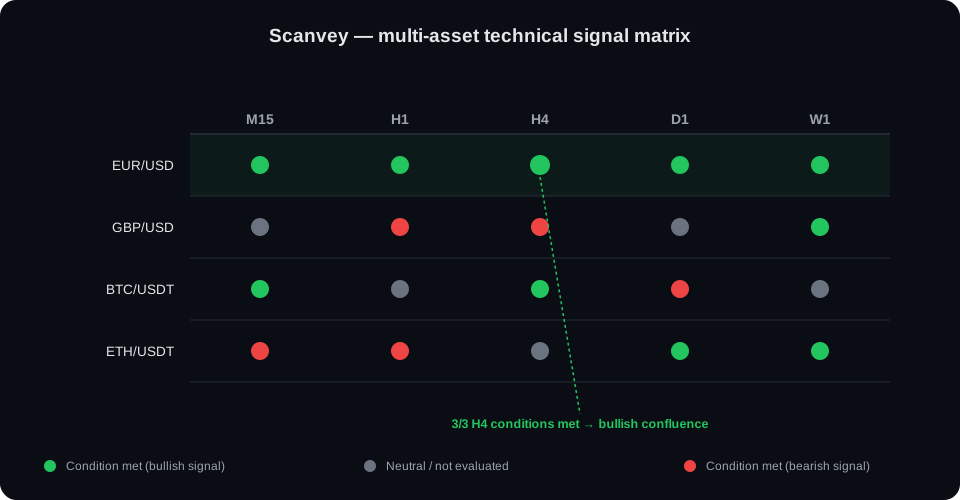
Steps 1–3 of this sequence — D1 trend, D1 RSI, H4 MACD — are the ones that scale poorly across a watchlist, since each requires its own chart. Scanvey checks all three conditions simultaneously for every pair, so the multi-category alignment described above is visible before you get to the structural and entry-timing steps that still require a human eye.
The Ichimoku Enhancement
For traders willing to learn the additional complexity, replacing the bare MA system with Ichimoku extends the combination significantly without adding a separate indicator.
Ichimoku handles all of Category 1 (trend direction via cloud position) and much of Category 3 (structural context via the Kijun-sen as dynamic support and the cloud as projected future support/resistance). This means Ichimoku + RSI + MACD + entry candle is a complete four-category combination using only three indicators, where Ichimoku does the work of two categories simultaneously.
The full Ichimoku + RSI + MACD combination:
Trend regime: Price above Ichimoku cloud on D1 = bullish. Cloud below price = support. Bullish Kumo Twist projected = confirming forward structure.
Entry level: Price pulls back to the Kijun-sen (Ichimoku base line, the key dynamic support in an uptrend). The Kijun acts as the structural level in Step 4.
Momentum confirmation: RSI recovers above 50 as price tests the Kijun. MACD histogram on H4 turns from negative to positive at the Kijun level.
Entry trigger: Bullish TK cross (Tenkan crossing above Kijun) combined with a bullish H4 pin bar at the Kijun level. The candle and the Ichimoku signal confirm simultaneously.
Chikou confirmation: Chikou Span (current price plotted 26 bars back) sits above prior price bars and above the cloud from 26 periods ago — confirming the bullish momentum trajectory from a historical comparison perspective.
This combination — Ichimoku + RSI + MACD — provides an extraordinary depth of confirmation from three tools applied coherently. Each element answers a different question about the same directional setup.
What Not to Combine: The Redundancy Trap
Understanding which combinations to avoid is as important as knowing which to use.
Multiple oscillators (RSI + Stochastic + CCI): All three measure momentum in slightly different ways. In strong trends, all three will be simultaneously "overbought" or "oversold" — creating a false impression of strong divergent signals when in reality they are all saying the same thing. Use one.
Multiple trend-following indicators of similar period (EMA20 + SMA20 + DEMA20): Three moving average systems using similar periods will almost always agree with each other. Adding them creates visual complexity without analytical depth. One MA system with two or three periods (fast/slow/long) is sufficient.
Lagging + lagging confirmation (MA crossover confirmed by MACD crossover): Both MAs and MACD are derived from moving averages. A MACD crossover and a nearby MA crossover are often caused by the same underlying price movement — they are correlated rather than independent. Using MACD as confirmation of a MA crossover, or vice versa, overstates the evidence. Genuine confirmation comes from independent categories (e.g., MA crossover + RSI level = trend + momentum, two genuinely different measurement approaches).
Bollinger Bands + ATR + Keltner Channels: All three are volatility-envelope indicators derived from price and standard deviations or ATR. Using all three on the same chart provides three versions of the same volatility measurement. Use one if volatility context is needed; pair it with something from a different category.
Calibrating Indicator Combinations to Market Conditions
No combination works equally well in all market conditions. The best traders maintain a mental model of which combination is appropriate for the current environment.
Trending conditions: MA + RSI + MACD is the core combination. Trend-following setups at key levels with full indicator alignment. Ichimoku TK crosses above the cloud provide clean entries. Divergence signals are lower priority — in a strong trend, divergence can persist for weeks before materialising into a reversal.
Ranging conditions: The same indicators, different application. RSI oscillator framework (overbought near 65 at range top, oversold near 35 at range bottom) replaces the momentum regime framework. MA crossovers are unreliable as directional signals — use them as exits from range-bound positions rather than entries into new ones. Focus on structural levels (horizontal support and resistance) rather than dynamic MA levels.
Transitional conditions (trend to range or range to trend): Reduce indicator weight and increase structural weight. When MAs are converging and RSI is oscillating near 50, the market is providing ambiguous signals. Wait for one of the regime indicators (MA50/MA200 separation, RSI establishing above or below 50) to clarify before taking full-size positions.
Reading Conflicting Signals
Even a well-designed combination will occasionally produce conflicting signals. D1 bullish but H4 MACD still negative. RSI above 50 but MACD histogram declining. Ichimoku cloud bullish but TK cross not yet formed. How to handle these?
Prioritise the higher timeframe. D1 signals outrank H4 signals. If D1 is clearly bullish (golden cross, RSI above 55, MACD positive) but H4 is in a pullback correction (H4 MACD negative, H4 RSI at 42), there is no conflict — the H4 correction is a normal event within the D1 uptrend. Wait for H4 to recover before entering; the D1 context tells you the direction.
Prioritise categorical independence. A conflict between RSI and MACD — two momentum indicators — is less significant than a conflict between a trend indicator and a momentum indicator. If the MA system says bullish but RSI says bearish momentum, that is a genuine structural conflict worth respecting. If MACD says positive momentum but RSI is at 48 (just below 50), that is a borderline signal, not a conflict — wait for RSI to cross above 50.
Pass on genuinely ambiguous setups. When multiple independent categories are in conflict with no clear resolution, the setup does not have the confluence it needs. Pass. The market produces dozens of potential setups per week across all pairs; there is no shortage of future opportunities. Forcing an entry on ambiguous signals is how average setups crowd out the high-quality ones.
A Practical Reference: The Complete Combination Framework
For reference, here is the complete indicator combination framework in condensed form:
Trend (Category 1): D1 MA50 vs MA200 alignment + Ichimoku cloud position (price above/below)
Momentum (Category 2): D1 RSI above/below 50 + H4 MACD histogram direction
Structure (Category 3): H4 key level (swing high/low, MA50, Kijun-sen, Fibonacci)
Entry (Category 4): H4 or H1 closed candle pattern (pin bar, engulfing, inside bar breakout)
All four categories aligned in the same direction = high-confluence setup, full position size. Three of four aligned = moderate confluence, reduced size or pass. Two of four or fewer = pass.
Scanvey displays the indicator conditions from Categories 1 and 2 — MA crossovers, RSI levels, MACD direction, Ichimoku cloud — for all pairs across all timeframes simultaneously. The matrix shows at a glance which pairs have multi-category alignment, directing manual analysis to the structural level and entry pattern assessment (Categories 3 and 4) where genuine judgment is required. The mechanical filtering is automated; the analytical work remains human.
Conclusion
The goal of indicator combination is not to confirm a trade you have already decided to take. It is to build an objective case from independent evidence that a high-probability directional setup exists — and to remain honest when that case is incomplete.
A minimal set of well-chosen indicators from genuinely different categories, applied in a disciplined sequence, produces clearer analysis and better trades than a chart covered in every indicator ever invented. Fewer signals, better filtered, is the principle that separates systematic traders from reactive ones.
Learn one indicator from each category deeply. Understand what it measures and when it fails. Combine them with structural context and a precise entry trigger. Apply that combination consistently, and assess the results over a meaningful sample. That is the process. Everything else is noise.
Related articles:
- RSI in Forex: Best Settings and Strategy Guide
- MACD Forex Trading: Complete Strategy Guide
- Ichimoku Cloud Forex: How to Trade It Effectively
- Forex Confluence Trading: How Multiple Signals Work
- How to Spot Potential Market Reversals, the complete guide — a special case of this confluence, applied specifically to reversals (momentum, trend exhaustion, divergence)
Frequently asked questions
How many indicators should I use in forex trading?
Two to four indicators is the right range for most traders, with each one serving a distinct analytical function. The minimum effective combination is a trend indicator (moving averages) plus a momentum indicator (RSI or MACD). Adding a third for structural confirmation (Ichimoku cloud or support/resistance levels) is often beneficial. Beyond four indicators, you are almost always creating redundancy — adding indicators that measure the same underlying price data from a slightly different angle — which increases conflicting signals without adding genuine information.
What is the best indicator combination for forex trading?
The most consistently effective combination is: MA50 + MA200 for trend direction, RSI(14) for momentum regime and divergence, and MACD(12,26,9) for momentum confirmation and timing. This gives you one trend tool, one regime indicator, and one momentum tool — three genuinely independent analytical categories. For traders who want structural context added, the Ichimoku cloud provides dynamic support/resistance on top of trend information, making it a strong fourth element.
Why do too many indicators hurt trading performance?
More indicators mean more data, but not more insight — because all indicators are transformations of the same price data. When you add a fifth and sixth indicator, they will periodically disagree with the first four, creating paralysis rather than clarity. More critically, a system that requires all six indicators to agree will generate very few signals, and a system that requires only a majority will produce more signals than a cleaner three-indicator system without meaningfully improving their quality.
Which technical indicators work best together in forex?
Indicators from different analytical categories work best together: trend direction (moving averages) + momentum regime (RSI) + timing signal (MACD) is the classic combination. Adding Ichimoku for dynamic support/resistance gives a fourth genuinely independent layer. What does not work is combining multiple indicators from the same category — RSI + Stochastic + CCI are all momentum oscillators and will produce nearly identical signals. Choose one per category.
Can I combine indicators across different timeframes, not just different categories?
Yes, and this is often more powerful than combining categories on a single timeframe. A common approach reads the trend indicator on D1, the momentum indicator on D1 or H4, and a faster indicator on H4 or H1 for entry timing — spreading the four analytical categories across the timeframe hierarchy rather than stacking them all on one chart. This mirrors the multi-timeframe top-down process more closely than a single-timeframe combination does.
Should the same indicator combination be used on every pair?
The categories should stay consistent — trend, momentum, structure, entry — but the specific settings can reasonably vary. A pair with wider average daily ranges may need a slightly longer moving average period to avoid excessive whipsaw, while a tighter-ranging pair can use faster settings without adding noise. What should not change from pair to pair is the number of categories required to align before taking a trade.
Further reading
These reference resources complement the analysis presented in this article:
Related reading
Spot indicator confluence instantly
The matrix flags the moments when multiple technical conditions align at once.
Discover ScanveyThis article is for informational and educational purposes only. It does not constitute investment advice or a trading signal. Trading financial products involves a high risk of capital loss. Full risk disclaimer