Ichimoku Cloud Forex: How to Trade It Effectively
Learn how to read and trade the Ichimoku Cloud in forex. Cloud direction, Tenkan/Kijun cross, Chikou span, and the best timeframes to extract reliable signals.
Published on 4 June 2026
Most indicators tell you where price has been. The Ichimoku Cloud tells you where price is, where it came from, and where it is likely to find support or resistance in the future — all at the same time.
This is what makes Ichimoku unusual among technical indicators: it is not one signal, it is a complete analytical system. Developed in Japan in the late 1960s by journalist Goichi Hosoda (who published under the pen name Ichimoku Sanjin after thirty years of research), it was designed to provide a comprehensive view of price dynamics at a single glance. The name itself translates roughly as "one look equilibrium chart."
Western traders often find Ichimoku visually overwhelming at first — five lines, a shaded cloud, signals scattered across the chart. But the system has a clear internal logic, and once that logic is understood, it becomes one of the most powerful tools available for forex analysis.
The Five Components of Ichimoku
Understanding the system begins with understanding what each component represents and how it is calculated.
| Component | Japanese Name | Calculation Period | Role |
|---|---|---|---|
| Tenkan-sen | Conversion Line | 9 periods | Short-term momentum; fastest line in the system |
| Kijun-sen | Base Line | 26 periods | Medium-term equilibrium; key support/resistance |
| Senkou Span A | Leading Span A | (Tenkan+Kijun)/2, plotted 26 ahead | Cloud boundary; dynamic support/resistance |
| Senkou Span B | Leading Span B | 52-period midpoint, plotted 26 ahead | Slower cloud boundary; stronger S/R zone |
| Chikou Span | Lagging Span | Current close plotted 26 periods back | Confirms trend by comparing price to past context |
Tenkan-sen (Conversion Line)
The Tenkan-sen is calculated as the midpoint of the highest high and lowest low over the past 9 periods.
Tenkan-sen = (Highest High over 9 periods + Lowest Low over 9 periods) / 2
It is not a moving average of closing prices — it is the midpoint of the price range over the lookback period. This distinction matters: it measures the equilibrium point of the recent price range rather than a smoothed directional average. When price is trending, the Tenkan-sen slopes in the direction of the trend. When price is consolidating, it flattens.
The Tenkan-sen is the fastest line in the Ichimoku system. It reacts to price changes quickly and acts as the first reference for short-term momentum.
Kijun-sen (Base Line)
The Kijun-sen uses the same calculation as the Tenkan-sen, but over 26 periods.
Kijun-sen = (Highest High over 26 periods + Lowest Low over 26 periods) / 2
It represents the equilibrium of the medium-term price range. The Kijun-sen is slower and more significant than the Tenkan-sen. Price tends to gravitate back toward the Kijun-sen after extended moves — a characteristic that gives it a strong support/resistance function. In a trend, pullbacks to the Kijun-sen are often the optimal entry point for trend continuation trades.
Senkou Span A (Leading Span A)
Senkou Span A is the first boundary of the cloud:
Senkou Span A = (Tenkan-sen + Kijun-sen) / 2, plotted 26 periods into the future
This is the distinctive feature of Ichimoku: two of its five components are plotted ahead of current price. Senkou Span A projects the midpoint of the Tenkan/Kijun equilibrium into the future, creating a forward-looking support or resistance boundary.
Senkou Span B (Leading Span B)
Senkou Span B is the second boundary of the cloud:
Senkou Span B = (Highest High over 52 periods + Lowest Low over 52 periods) / 2, plotted 26 periods into the future
Senkou Span B captures the equilibrium of a longer-term range (52 periods) and also projects it 26 periods forward. Together with Senkou Span A, it forms the Kumo — the cloud.
The cloud is shaded bullishly (typically green) when Senkou Span A is above Senkou Span B, and bearishly (typically red) when Span B is above Span A. The thickness of the cloud represents the strength of support or resistance in that zone: a thick cloud is harder for price to penetrate; a thin cloud offers less resistance.
Chikou Span (Lagging Span)
The Chikou Span is simply the current closing price plotted 26 periods in the past.
Chikou Span = Current closing price, shifted back 26 periods
Its purpose is to compare current price to where price was 26 periods ago. If the Chikou Span (current price, plotted in the past) is above the price bars from 26 periods ago, it confirms bullish momentum. If it is below, bearish momentum is confirmed. If the Chikou Span is inside the price bars or the cloud from 26 periods ago, the signal is mixed or blocked.
The Kumo: The Heart of the System
The cloud (Kumo) is the element that makes Ichimoku visually distinctive and analytically powerful.
Price position relative to the cloud defines the macro regime:
- Price above the cloud = bullish regime. The cloud below price acts as layered support.
- Price below the cloud = bearish regime. The cloud above price acts as layered resistance.
- Price inside the cloud = uncertain or transitional market. Avoid new directional positions until price exits cleanly.
This single condition — where price sits relative to the cloud — is one of the fastest and most reliable regime filters available. It requires no calculation and no subjectivity: price is either above, below, or inside the cloud.
The Kumo Twist (cloud colour change): When the projected cloud changes from bearish (red) to bullish (green) or vice versa 26 periods in the future, it is called a Kumo Twist. This is a forward-looking signal: it indicates that the current trend structure suggests a potential shift in the cloud's character ahead. A bullish Kumo Twist — projected cloud turning green — is a confirmation that current conditions may support a coming bullish phase. It does not guarantee a reversal but provides additional context when combined with other signals.
Cloud thickness as a volatility indicator: A thin cloud means Senkou Span A and Span B are close together — the support/resistance zone is narrow and price may break through it relatively easily. A thick cloud signals a wide, well-established support/resistance zone that required sustained momentum to form. Price often consolidates around or within thick cloud zones before resolving.
The TK Cross: The Primary Trade Signal
The Tenkan/Kijun cross — often called the TK cross — is the main entry signal in the Ichimoku system.
Bullish TK cross: Tenkan-sen crosses above Kijun-sen. This signals that short-term equilibrium (Tenkan) has moved above medium-term equilibrium (Kijun) — recent momentum is stronger than the prevailing baseline. The significance of the signal depends on its position relative to the cloud:
- Strong bullish signal: TK cross occurs while price is above the cloud. All major components are aligned bullishly.
- Neutral bullish signal: TK cross occurs while price is inside the cloud. The signal exists but is partially obscured by the cloud's resistance.
- Weak bullish signal: TK cross occurs while price is below the cloud. The signal is fighting the dominant bearish regime — treat with scepticism.
Bearish TK cross: Tenkan-sen crosses below Kijun-sen. The same three-tier classification applies in reverse.
The TK cross is not equally reliable in all market conditions. In strong trending markets, it is a powerful momentum confirmation. In ranging, choppy markets, it generates frequent false signals as the Tenkan and Kijun oscillate around each other. This is why the cloud position check is essential: a TK cross above the cloud in a trending market is a high-quality signal; a TK cross inside the cloud during a ranging period is noise.
Reading the TK cross correctly requires checking it against the cloud position for every pair, every session — two separate visual checks per chart. Scanvey computes both together and surfaces the combined score across your whole watchlist, so a strong bullish TK cross above the cloud is flagged directly instead of requiring the cross-referencing described above chart by chart.
The Chikou Span Confirmation
The Chikou Span is often the least-understood component of Ichimoku, but it adds a dimension of confirmation that other indicators cannot replicate.
When entering a long trade, check the Chikou Span:
- Is the Chikou Span (current price, plotted 26 bars back) above the price bars from 26 periods ago? ✓
- Is the Chikou Span above the cloud from 26 periods ago? ✓
If both conditions are met, it confirms that current prices are not only bullish in the present structure but that the momentum trajectory — looking at current price versus where it was 26 bars ago — is also bullish. This historical perspective eliminates setups where current price looks bullish but is actually retracing back into prior resistance.
The Chikou Span confirmation is not always required for every trade, but it strengthens the signal quality when it aligns. A complete Ichimoku bullish signal — price above cloud, bullish TK cross above the cloud, Chikou Span above prior price bars and cloud — is one of the most robust confluence signals in technical analysis.
Kijun-sen as Support and Resistance
Beyond the TK cross signal, the Kijun-sen has a well-documented function as dynamic support and resistance in trending markets.
In a bullish regime (price above cloud), the Kijun-sen frequently acts as the equilibrium level that price gravitates toward during pullbacks. A pullback to the Kijun-sen in an established uptrend, followed by a bounce, is a high-quality continuation trade setup — often combined with a Tenkan/Kijun recross or a candle reversal pattern at the Kijun level.
The practical application: once a bullish regime is confirmed by price above the cloud and a TK cross, mark the Kijun-sen as your key dynamic support. Pullbacks that hold the Kijun-sen are the optimal re-entry or initial entry points for trend continuation. Pullbacks that break below the Kijun-sen and fail to recover are early warnings that the trend may be weakening.
In a bearish regime, the same logic applies in reverse: the Kijun-sen acts as dynamic resistance, and bounces to the Kijun-sen that fail to close above it are the optimal short entry points.
Best Timeframes for Ichimoku in Forex
Ichimoku's standard settings (9/26/52) were developed for Japanese stock markets that traded six days a week. On those markets, the settings represented approximately 1.5 weeks, 1 month, and 2 months of trading history respectively — creating a natural hierarchy of short, medium, and long-term equilibrium.
In forex (which trades five days a week), the same periods represent slightly different time spans:
- 9 periods on D1 = 9 trading days (approximately 2 weeks)
- 26 periods on D1 = 26 trading days (approximately 1 month)
- 52 periods on D1 = 52 trading days (approximately 2.5 months)
These remain meaningful for daily chart analysis on forex pairs. The settings work well on D1 and H4 — the two timeframes where most serious forex swing traders operate.
D1 Ichimoku: Most reliable for establishing the macro regime and identifying medium-term trade setups. Cloud signals on D1 have strong historical reliability on major forex pairs. The 26-period forward projection on D1 represents approximately one month of future price structure — highly relevant for swing trade planning.
H4 Ichimoku: Works well for identifying entry structure within a D1-established trend. TK crosses on H4, confirmed by D1 cloud regime, produce reliable swing entry signals. The forward projection on H4 (26 × 4 hours = approximately 4.3 days ahead) is a useful short-term structural reference.
H1 and below: Ichimoku signals degrade significantly on lower timeframes due to the speed of price movement relative to the indicator's lookback periods. The 26-period cloud projection on H1 covers only 26 hours ahead — too short to filter meaningful structure from noise. Use Ichimoku primarily on H4 and D1.
A Complete Ichimoku Trade Setup
Combining all five components, here is what a full Ichimoku trade setup looks like in practice.
Market context: EUR/USD, D1 chart. The pair has been in an uptrend for six weeks.
Step 1 — Cloud regime check: Price is above the cloud on D1. Cloud below price is green (bullish). Confirmed bullish regime. ✓
Step 2 — Kumo Twist check: Projected cloud 26 periods forward shows a bullish twist — the cloud ahead is green. ✓
Step 3 — Price versus Kijun: Price has pulled back during a two-week correction. It is now at the Kijun-sen level (approximately 1.0860). The Kijun acts as potential support.
Step 4 — TK cross watch: During the pullback, the Tenkan crossed below the Kijun (bearish TK cross — normal during a pullback). Now, as price tests the Kijun, the Tenkan is beginning to converge back toward the Kijun from below. A bullish TK recross is forming.
Step 5 — Chikou Span confirmation: Current price (plotted 26 bars back) is above the price bars from 26 periods ago and above the cloud from that period. ✓
Step 6 — Entry candle: A D1 pin bar forms at the Kijun-sen level, with a long lower wick and a close above the Kijun. Entry signal confirmed.
Entry: Long at market on the next daily open. Stop: Below the Kijun-sen with buffer, just below the top of the cloud. Target: Next structural resistance / prior swing high — approximately 200 pips higher.
Every Ichimoku component has contributed to the analysis: the cloud defined the regime, the Kumo Twist confirmed forward structure, the Kijun provided the entry level, the TK cross provided the momentum signal, and the Chikou Span confirmed the historical momentum trajectory.
Ichimoku Alongside Other Indicators
Ichimoku is comprehensive but not infallible. Combining it with a small number of complementary indicators improves signal quality.
RSI confirmation: RSI recovering above 50 at the same time as a bullish TK cross adds a pure momentum confirmation that is independent of the Ichimoku calculations. RSI divergence (price making lower lows while RSI makes higher lows) at the cloud support zone is a particularly powerful signal.
MACD confirmation: MACD histogram turning positive at the Kijun-sen or cloud support confirms that momentum is shifting back in the bullish direction. Combined with a TK cross, this creates genuine multi-indicator confluence.
Volume (where available): In forex, volume data is limited (tick volume rather than true volume), but a spike in tick volume at the Kijun-sen or cloud boundary adds weight to a reversal signal.
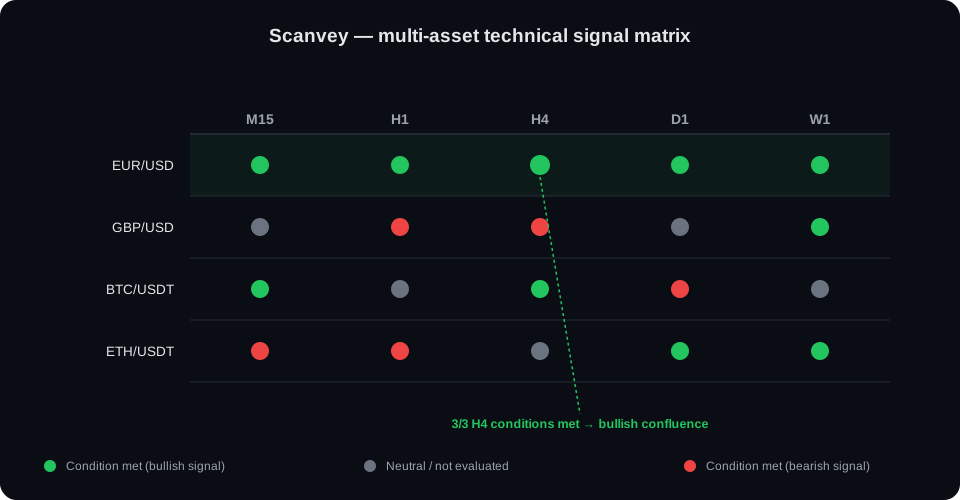
Scanvey tracks Ichimoku conditions — cloud regime, TK cross status, and price position relative to the cloud — alongside MA crossovers, RSI, and MACD for all pairs across all timeframes simultaneously. This matrix view allows traders to see, at a glance, which pairs have multiple Ichimoku and indicator conditions aligned, without manually opening each chart to check each component.
The Ichimoku scanner page itself shows exactly that matrix: pairs as rows, timeframes as columns, and a color-coded 0-6 score in each cell — you spot the strong setups without recalculating the five components by hand.
Common Ichimoku Mistakes
Trading TK crosses in ranging markets. The TK cross generates frequent false signals in sideways markets where the Tenkan and Kijun oscillate around each other. Always check whether price is above, below, or inside the cloud before acting on a TK cross. Inside the cloud = low confidence for any TK signal.
Ignoring cloud thickness. Price often struggles to break through thick clouds cleanly. Expecting a swift breakout through a wide, thick cloud leads to premature entries. Wait for price to close beyond the far edge of the cloud before treating the breakout as confirmed.
Using Ichimoku on M15 or M5. The standard settings are calibrated for higher timeframes. On M15, the 26-period cloud covers only 6.5 hours of projected structure — too short to be analytically meaningful. Stick to H4 and D1.
Treating partial Ichimoku signals as complete ones. A bullish TK cross below the cloud is a weak signal. A price break above the cloud without a TK cross is incomplete. The full signal requires cloud position, TK cross position, and ideally Chikou confirmation. Partial signals should be sized down or passed.
Conclusion
The Ichimoku Cloud is not a shortcut — it requires genuine study before it becomes useful. But the investment pays compounding dividends: once you can read a chart in Ichimoku terms, you simultaneously see the trend regime, the dynamic support and resistance, the momentum signal, and the forward structural projection in a single view.
No other single indicator provides this breadth of information. The learning curve is real; the analytical depth it unlocks is equally real.
Start with the cloud: price above or below. Add the TK cross: bullish or bearish, and where relative to the cloud. Add the Kijun as your key support/resistance reference. The Chikou Span and the Kumo Twist add precision as your familiarity grows. With time, the visual complexity that initially overwhelms becomes the clarity that sets your analysis apart.
Related articles:
- Multi-Timeframe Analysis: The Complete Guide
- Technical Indicators Combination Guide
- Forex Confluence Trading: How Multiple Signals Work
- Daily Chart Forex Analysis
Frequently asked questions
Is the Ichimoku Cloud a reliable system for forex trading?
Yes — Ichimoku is one of the most comprehensive technical systems available for forex, precisely because it provides simultaneous information about trend direction, momentum, and future support/resistance. Its reliability is highest on the daily and weekly charts for the major liquid pairs, where clean trends are more common. On lower timeframes or illiquid pairs, the cloud can produce noisy signals that require additional confirmation.
What is the best timeframe to use Ichimoku on for forex?
The daily chart (D1) is the most commonly recommended primary timeframe for Ichimoku in forex. The system was designed by Hosoda with daily charts in mind, and its standard settings (9, 26, 52 periods) are calibrated to daily candles. Many traders use the D1 Ichimoku for trend direction and the H4 for entry timing, which aligns with the standard multi-timeframe approach — see multi-timeframe Ichimoku analysis for the full method.
Should I adjust Ichimoku's default settings for forex?
The default settings (Tenkan 9, Kijun 26, Senkou Span B 52) are the most widely used and therefore the most self-fulfilling — the more traders reference the same levels, the more those levels attract real order flow. Changing the settings reduces this self-fulfilling property. Most experienced Ichimoku traders use the defaults on D1 and W1, and only adjust settings on lower timeframes where the defaults can produce too many signals.
Should I use Ichimoku on its own or combine it with other indicators?
Ichimoku is designed as a complete standalone system, and many traders use it without additional indicators. However, combining it with RSI for momentum confirmation and volume-based analysis where available does improve signal quality. The most important rule is to avoid adding indicators that measure the same thing — Ichimoku already incorporates trend, momentum, and support/resistance. Adding MACD on top adds some value; adding three more moving averages adds none.
What does a weak Ichimoku signal look like?
A weak signal is one where the components disagree — for example, a bullish TK cross occurring while price is still inside or below the cloud, or a Chikou Span that has not cleared price from 26 periods back. A strong signal requires the cloud position, the TK cross, and the Chikou confirmation to all point the same direction; when only one or two components align, the signal should be treated with more caution.
Further reading
These reference resources complement the analysis presented in this article:
Related reading
Track every indicator in one matrix
MA, RSI, MACD and Ichimoku calculated automatically across your entire watchlist.
Discover ScanveyThis article is for informational and educational purposes only. It does not constitute investment advice or a trading signal. Trading financial products involves a high risk of capital loss. Full risk disclaimer